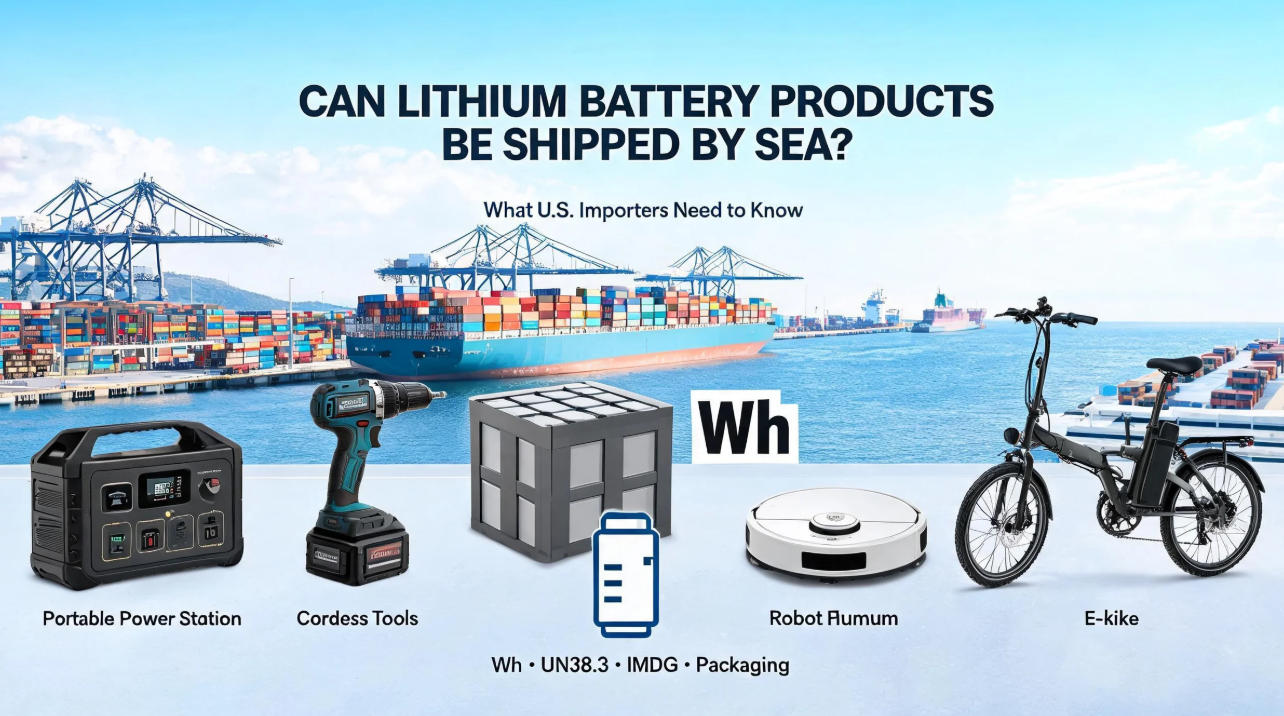
More and more products imported from China contain lithium batteries — from cordless tools and vacuum cleaners to power stations, electric bikes, toys, and portable electronics.
One of the most common questions we receive is:
“Can I ship a product with a lithium battery from China to the U.S. by sea?”
The short answer is: Yes, in many cases. But lithium battery shipments are regulated, and the requirements depend on the battery type, capacity, configuration, packaging, and transportation method.
- There Is No Simple “Battery Size Limit”
A common misconception is that ocean freight has a single maximum battery capacity.
In reality, there is no universal rule saying that a lithium battery above a certain Wh value simply cannot be shipped by sea.
Instead, different requirements can apply depending on factors such as:
- Battery chemistry
- Watt-hour rating (Wh)
- Whether the battery is installed in the product
- Whether it is packed with the product
- Whether it is shipped separately
- Battery condition
- Packaging
- UN classification
- Carrier requirements
For shipments to, from, or within the United States, lithium batteries are regulated under the U.S. Department of Transportation’s Hazardous Materials Regulations (HMR). International ocean transportation also involves the International Maritime Dangerous Goods (IMDG) Code.
The current IMDG Code 2024 edition, incorporating Amendment 42-24, became mandatory on January 1, 2026.
- The Number You Need Is Wh — Not Just Watts
When a supplier tells you:
“This product is 1,000W.”
That does not tell a freight forwarder enough about the battery.
There is an important difference:
W = Power
Wh = Energy Capacity
For a battery, a basic calculation is:
Wh = Voltage (V) × Amp-hours (Ah)
For example:
48V × 20Ah = 960Wh
So if a customer says their product has a “1,000W battery,” ask for the actual battery capacity in Wh.
This is particularly important for products such as portable power stations, electric bicycles, electric scooters, cordless tools, and other battery-powered equipment.
- Why 100Wh Is an Important Threshold
For lithium-ion batteries, 100Wh is an important regulatory threshold, but it should not be interpreted as a simple “100Wh or less = ordinary cargo” rule.
The U.S. PHMSA’s current lithium battery guidance contains different requirements depending on battery size and configuration. In particular, batteries above 100Wh are subject to additional requirements in certain transportation scenarios.
For example:
Small lithium-ion battery
A cordless device may contain a battery such as:
36V × 2.5Ah = 90Wh
This is below 100Wh.
It may still be regulated as a lithium battery shipment, but its requirements can differ from a large standalone battery.
Larger battery
A portable power station may contain:
51.2V × 20Ah = 1,024Wh
This is far above 100Wh.
It should not be treated like a small consumer-electronics battery. The shipment needs to be evaluated based on its specific configuration and applicable dangerous-goods requirements.
PHMSA has also clarified that lithium-ion batteries above 100Wh can be subject to stricter requirements than batteries falling within certain exceptions.
- Installed Battery vs. Standalone Battery Matters
The same battery can have different transportation requirements depending on how it is shipped.
There is an important distinction between:
Battery contained in equipment
Battery packed with equipment
Standalone battery
For example:
- A cordless vacuum cleaner with the battery installed
- A power tool shipped together with a separate battery
- A carton containing only replacement batteries
These are not necessarily treated in exactly the same way.
This is why simply telling your freight forwarder:
“It has a lithium battery.”
is usually not enough.
- UN38.3 Is One of the Key Documents
For lithium battery shipments, one of the most important things to check is UN 38.3.
Lithium cells and batteries offered for transportation must meet the applicable design-testing requirements under Section 38.3 of the UN Manual of Tests and Criteria. Manufacturers must also make the relevant test summary available.
Depending on the shipment, the forwarder may also request documents such as:
- UN38.3 Test Summary
- SDS/MSDS
- Battery specification
- Product specification
- Battery capacity information
- Battery model
- Packing information
- Dangerous goods declaration, when applicable
Having these documents ready can significantly speed up the booking and compliance review process.
- Damaged Batteries Are a Different Story
A particularly important point is that damaged, defective, or recalled lithium batteries should never be treated like normal lithium battery cargo.
Lithium batteries can experience short circuits, overheating, and thermal runaway. PHMSA specifically identifies damaged, defective, and recalled batteries as presenting increased transportation risks.
If a shipment contains:
- Swollen batteries
- Damaged batteries
- Leaking batteries
- Recalled batteries
- Batteries with suspected internal damage
Tell your freight forwarder before booking.
Do not simply describe them as “normal batteries.”
- Common Products That Need Extra Attention
Some products frequently require additional review before ocean freight booking.
Portable Power Stations
Often contain large lithium-ion battery packs, sometimes hundreds or thousands of Wh.
Electric Bicycles & Scooters
The battery capacity can be substantially higher than ordinary consumer electronics.
Cordless Power Tools
Usually contain smaller lithium batteries, but the exact configuration still matters.
Robotic Vacuum Cleaners
Usually contain lithium batteries installed inside the equipment.
Battery-Powered Toys
Often involve relatively small batteries, but the exact battery type and configuration should still be confirmed.
UPS & Backup Power Systems
May contain large battery packs and require additional transportation review.
Solar Energy Storage Equipment
Often involves high-capacity battery systems and should be reviewed before booking.
- Don’t Ask Only “How Many Batteries?”
Another common mistake is focusing only on the quantity.
For example:
“We have 500 batteries. Can you ship them?”
This information is not enough.
A freight forwarder needs to know:
What type of battery?
What is the Wh rating?
Are they installed in equipment?
Are they packed with equipment?
Are they shipped separately?
Do they have UN38.3 documentation?
How are they packaged?
The quantity is important, but it is only one part of the assessment.
- What Should You Tell Your Freight Forwarder?
If you are importing battery-powered products from China to the U.S., prepare the following information before requesting a freight quote:
Product name
Battery type
Battery voltage (V)
Battery capacity (Ah)
Battery energy (Wh)
Number of batteries
Battery contained in / packed with / standalone
UN38.3 Test Summary
SDS/MSDS
Product specification
Packaging information
This allows the logistics provider to determine the appropriate transportation process before the cargo reaches the warehouse.
- The Bottom Line
Lithium batteries do not automatically mean “cannot ship by sea.”
In many cases, battery-powered products can be transported from China to the United States by ocean freight.
But the correct question is not:
“How many watts can I ship?”
A better question is:
“What type of battery is it, how many Wh does it have, how is it shipped, and what documentation is available?”
For international ocean freight, lithium battery shipments must be evaluated under the applicable U.S. hazardous-material requirements and the IMDG Code. Carrier and routing requirements may also affect whether a particular shipment can be accepted.
Before booking a battery-powered shipment, provide the battery specifications and UN38.3 documentation to your freight forwarder.
A few minutes of compliance checking before shipment can prevent much bigger problems later — including booking rejection, cargo delays, additional charges, or customs and transportation issues.
Quick Rule for Importers
Don’t just tell your forwarder: “It has a battery.”
Tell them:
Battery type + V + Ah + Wh + quantity + configuration + UN38.3
That is the information that makes a battery shipment much easier to evaluate.