
The surprising answer may be that German companies are not leaving China. They are changing the way they operate in China.
Germany has spent years talking about reducing its economic dependence on China.
The political language is familiar: de-risking, diversification, supply-chain resilience and strategic dependence.
But corporate investment is telling a more complicated story.
According to a recent study by the German Economic Institute (IW), German companies increased their investment in China by roughly one-third during the first half of 2026. At the same time, German investment in the United States declined sharply.
At first glance, this appears contradictory.
If Germany wants to reduce its dependence on China, why are German companies putting more capital into China?
The answer may be found in a new model of globalization.
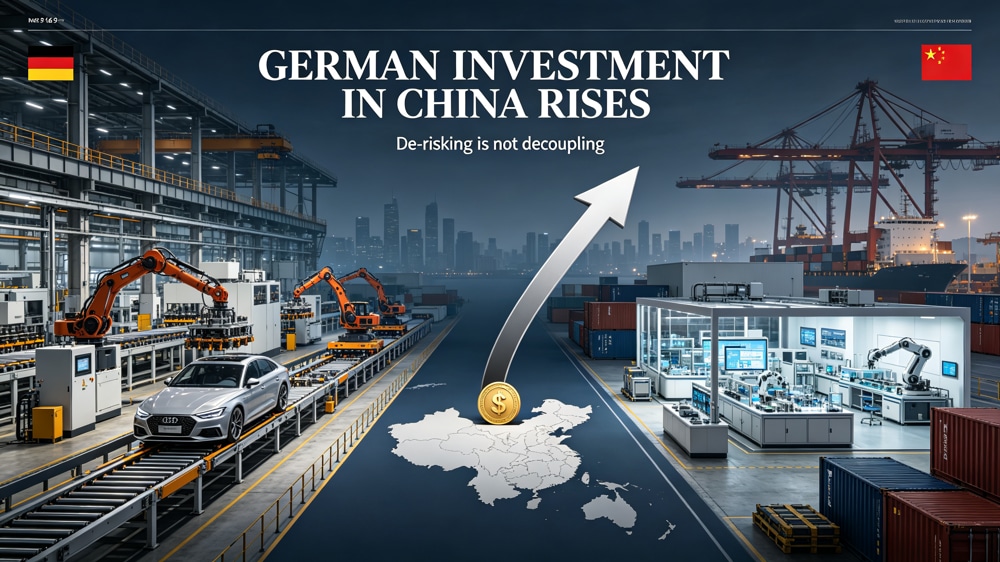
From “Made in China” to “Made for China”
For decades, one common model was relatively simple:
Germany → China → Global Markets
German companies manufactured high-value machinery, automotive products and industrial equipment in Germany or elsewhere, then exported them to customers around the world.
China was often viewed primarily as a manufacturing base and export platform.
That model is changing.
The new model increasingly looks like:
Germany → China → Chinese Market
or:
German Technology + Chinese Supply Chain + Local Production → China
This is a fundamentally different strategy.
Instead of producing everything in Germany and shipping it to China, companies can manufacture closer to Chinese customers, localize their supply chains and develop products specifically for the Chinese market.
This reduces transportation costs, shortens lead times and allows companies to respond faster to local competition.
China Is Becoming More Than a Factory
China’s importance to German companies is no longer simply about low-cost manufacturing.
China has developed one of the world’s deepest industrial ecosystems.
Machinery suppliers, electronics manufacturers, component producers, logistics companies, engineers, software developers and specialized industrial clusters are often located within relatively short distances of one another.
For companies operating in sectors such as automobiles, machinery, automation, industrial equipment and advanced manufacturing, this ecosystem itself has become an economic asset.
That creates a difficult strategic calculation.
A company may want to reduce geopolitical exposure to China.
But completely leaving the Chinese industrial ecosystem could also mean losing access to customers, suppliers, engineering talent and manufacturing capabilities.
This is why de-risking does not necessarily mean decoupling.
The New Question: Where Should Capital Be Located?
This may be the most important change in global manufacturing.
Companies are no longer asking only:
“Where can we manufacture at the lowest cost?”
They are increasingly asking:
“Where should our capital, production, engineering and supply chain be located to serve each market?”
That leads to a more regionalized manufacturing structure.
For example:
Europe → European customers
China → Chinese and Asian customers
Vietnam → Southeast Asian and selected export markets
Mexico → North American market
This does not mean globalization is disappearing.
Instead, globalization may be becoming more regional.
Germany’s China Strategy May Be More Pragmatic Than Political
There is an important distinction between government policy and corporate strategy.
Politically, Germany can argue that its dependence on China needs to be reduced.
Commercially, German companies can conclude that China remains too important to ignore.
Both positions can exist at the same time.
A German manufacturer may diversify production outside China while simultaneously expanding its Chinese factory.
It may source critical components from multiple countries while increasing R&D spending in China.
It may reduce its exposure to geopolitical risk without abandoning the Chinese market.
This is not necessarily a contradiction.
It is risk management through diversification.
Why the United States Is Losing Some Investment
The contrast with the United States is particularly interesting.
The IW data reported by Reuters shows German corporate investment moving in opposite directions: higher investment in China and significantly lower investment in the U.S. during the first half of 2026.
This does not mean German companies are abandoning the U.S. market.
The United States remains one of Germany’s most important economic partners.
But companies increasingly have to evaluate investment decisions through a much more complicated framework:
- Tariff exposure
- Market access
- Local manufacturing requirements
- Labor costs
- Energy costs
- Supply-chain depth
- Regulatory uncertainty
- Geopolitical risk
- Customer proximity
The cheapest factory is no longer necessarily the best factory.
The best location may be the one that provides the lowest total landed cost and lowest strategic risk.
What This Means for Global Logistics
For the logistics industry, this trend is particularly important.
If companies move toward regional manufacturing, the logistics model changes from simply:
Factory → Port → Destination
to something much more complex:
Multiple factories → Regional suppliers → Cross-border components → Local assembly → Regional distribution
That means logistics providers will increasingly need to understand more than freight rates.
They need to understand:
Origin.
Customs.
Tariffs.
Rules of origin.
Inventory positioning.
Regional distribution.
Supply-chain resilience.
A shipment may be physically simple but commercially complicated.
For example, a German company could manufacture a product in China using components from several Asian countries, sell it to a Chinese customer, and simultaneously export selected products from China to Europe or North America.
The logistics question is no longer simply:
“How much does it cost to ship this container?”
It becomes:
“What is the most efficient and compliant way to structure this supply chain?”
The Bigger Trend: Globalization Is Being Reorganized
The most interesting lesson from Germany’s increased investment in China may not be about Germany or China alone.
It may be about the future structure of global manufacturing.
The old model was increasingly global:
One factory → many global markets
The emerging model may be:
Multiple regional manufacturing hubs → multiple regional markets
China remains one of those hubs.
Vietnam, India, Mexico, Eastern Europe and other manufacturing centers are becoming additional layers.
Companies are not necessarily choosing China OR Vietnam, or China OR Mexico.
Increasingly, the strategy may be:
China + Vietnam + Mexico + Europe + North America
The goal is not to eliminate every risk.
The goal is to avoid depending entirely on one location.
De-Risking Does Not Mean Leaving China
Germany’s latest investment numbers provide a useful reminder:
Political risk and commercial reality do not always move in the same direction.
German policymakers may want to reduce strategic dependence on China.
German companies, however, still see value in China’s market, manufacturing ecosystem, engineering capabilities and supply-chain infrastructure.
So the next phase of globalization may not be about choosing between globalization and decoupling.
It may be about selective localization, regional diversification and smarter capital allocation.
The question for international businesses is no longer simply:
“Should we leave China?”
A more useful question may be:
“What should remain in China, what should move elsewhere, and how should the entire network work together?”
That is where the future of global supply chains is heading.
De-risking is not decoupling.
It may simply mean building a supply chain that is strong enough to operate even when the geopolitical environment changes.