
China and the United States are still strategic competitors. So why are Chinese companies signing long-term contracts to buy American natural gas?
The answer may tell us something important about the future of global trade.
On September 14, China Gas Holdings announced a new 20-year agreement with U.S.-based Venture Global to purchase 500,000 metric tons of LNG per year, with deliveries scheduled to begin in 2030.
The timing is particularly interesting.
The agreement comes while U.S.-China trade tensions remain significant, and shortly before a planned meeting between Chinese President Xi Jinping and U.S. President Donald Trump.
But the more important story is not the politics.
It is the economics.
Trade Wars Do Not Always Kill Trade
It is tempting to think of international trade as a simple equation:
Political tension → less trade
Reality is more complicated.
Countries can compete aggressively in technology, manufacturing and strategic industries while continuing to trade heavily in areas where both sides have economic incentives.
LNG is a good example.
The United States has become one of the world’s major LNG exporters.
China, meanwhile, remains one of the world’s largest energy markets.
Those two realities create a commercial connection that is difficult to eliminate completely.
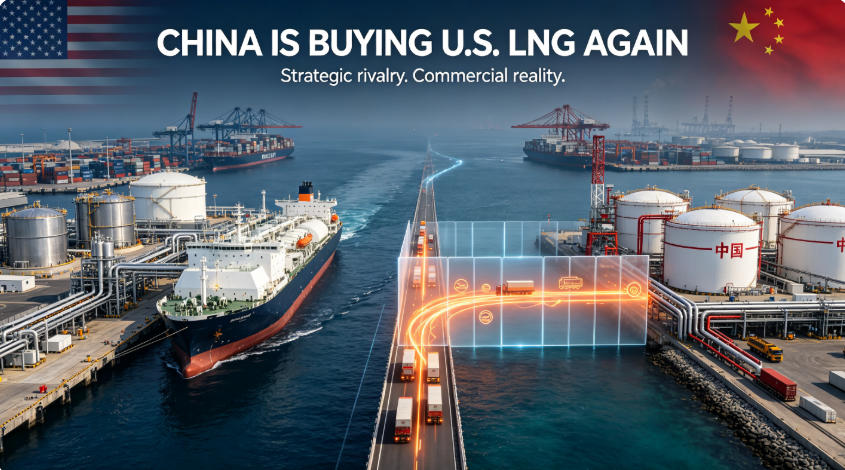
The result is an increasingly common pattern:
Strategic competition + commercial cooperation
Why Would China Sign a 20-Year U.S. LNG Contract?
There are several possible reasons.
- Energy diversification
China has increasingly diversified its natural gas supply.
Pipeline gas, domestic production, LNG from Australia, Qatar, Russia and other suppliers all form part of the broader energy portfolio.
A long-term U.S. LNG contract adds another source.
For an energy importer, diversification itself has strategic value.
- Long-term contracts reduce supply uncertainty
LNG markets can be extremely volatile.
Spot prices can rise dramatically during geopolitical crises, extreme weather or supply disruptions.
A long-term contract gives the buyer greater visibility over future supply.
That does not necessarily mean the contracted gas will always be the cheapest option.
It means the buyer has another layer of supply security.
- The U.S. has become an important LNG supplier
American LNG has a structural advantage: abundant domestic natural gas combined with large export infrastructure.
The U.S. is also continuing to expand LNG export capacity.
ExxonMobil executives recently said the United States could account for around 30% of the global LNG market by 2030.
For major Asian energy buyers, completely ignoring U.S. LNG would therefore become increasingly difficult.
But There Is a Bigger Story Here
The most interesting part of this deal may not be the 500,000 tons.
It is the 20-year duration.
A 20-year contract means both sides are making a commercial decision that extends far beyond the current political cycle.
That is important.
Companies invest based on expected economics over decades.
Governments may change tariffs every few years.
Trade restrictions can change.
Political relationships can deteriorate and improve.
But LNG infrastructure, terminals, ships and long-term supply contracts operate on much longer time horizons.
This creates an interesting separation:
Politics operates on election cycles.
Energy infrastructure operates on decades.
The Supply Chain Is Becoming More Pragmatic
This LNG agreement also fits into a much broader transformation in global supply chains.
Companies are increasingly asking:
Can we separate political risk from commercial necessity?
Sometimes the answer is yes.
A company may reduce dependence on one country for semiconductors while continuing to purchase another critical commodity from that same country.
A German manufacturer may diversify production outside China while increasing investment inside China.
A U.S. company may restrict certain Chinese technologies while continuing to rely on Chinese industrial components.
And now, Chinese energy companies can sign long-term contracts with U.S. LNG suppliers despite broader geopolitical competition.
These are not necessarily contradictions.
They are examples of selective decoupling and selective interdependence.
The New Global Trade Model: Compete and Cooperate
The old globalization model was largely built around one assumption:
Trade creates interdependence, and interdependence encourages cooperation.
The emerging model is different.
Countries can be economically interdependent while simultaneously competing over:
- Technology
- Manufacturing
- Energy
- Critical minerals
- Semiconductors
- Industrial capacity
- Strategic supply chains
In other words:
Interdependence is no longer disappearing. It is becoming more selective.
What Does This Mean for Logistics?
For international logistics companies, this trend has an important implication.
Cargo flows will not necessarily follow political headlines.
A country may impose tariffs on another country while trade in other sectors continues.
A supply chain may simultaneously:
Reduce exposure → diversify suppliers → maintain selected trade lanes → increase inventory buffers → establish alternative routes.
This makes logistics planning much more complicated.
The question is no longer simply:
“Which country is cheapest?”
It is becoming:
“Which combination of suppliers, countries, routes and inventory locations gives us the best balance of cost, risk and reliability?”
That is a much more sophisticated supply-chain problem.
China Buying U.S. LNG Is a Signal
The new LNG agreement should not be interpreted as the end of U.S.-China strategic competition.
Nor should it be dismissed as an isolated energy transaction.
It is better understood as another example of how global commerce is adapting to geopolitical fragmentation.
China may want greater energy security.
The United States wants more LNG exports and stronger demand for American energy.
Both sides have commercial interests.
Those interests can coexist with broader strategic competition.
And that may be one of the defining characteristics of the next phase of globalization.
The world may not be moving toward complete decoupling.
It may be moving toward selective interdependence.
Countries will compete where they consider strategic interests critical.
They will cooperate where commercial incentives remain too strong to ignore.
For businesses, that means the future supply chain will not simply be about choosing China or the U.S.
It will increasingly be about understanding where the two economies still intersect — and where they are deliberately moving apart.