For years, importers have watched tariffs as the main indicator of trade risk.
Now, that may no longer be enough.
The European Union is putting increasing pressure on China to address the bloc’s rapidly expanding trade deficit. Brussels wants to see tangible progress by early October 2026. If negotiations fail to produce meaningful results, political pressure for additional trade measures is expected to increase.
But there is an important distinction:
The EU is not currently announcing an immediate closure of its market to Chinese goods.
Instead, something potentially more important is happening.
Europe’s trade-defense toolkit is expanding from tariffs → quotas → public procurement restrictions → supply-chain controls.
For companies moving goods into Europe, this could change the meaning of “market access.”
The October Deadline Is About Results — Not a Market Shutdown
The October target should not be interpreted as:
“If China does not agree, Europe will close its market.”
The actual situation is more gradual.
The European Commission wants China to take concrete steps to address concerns over the trade imbalance, market access, industrial overcapacity and restrictions affecting critical raw materials.
The EU’s trade deficit with China reached approximately €360.6 billion in 2025, up 15% from the previous year, and widened by another 9% in the first half of 2026, according to Reuters.
Brussels is particularly concerned about rising Chinese exports in sectors including textiles, plastics, batteries and electric vehicles.
So October is better understood as a political and negotiating deadline, rather than a switch that automatically turns the European market off.
But the direction of travel is becoming increasingly clear.
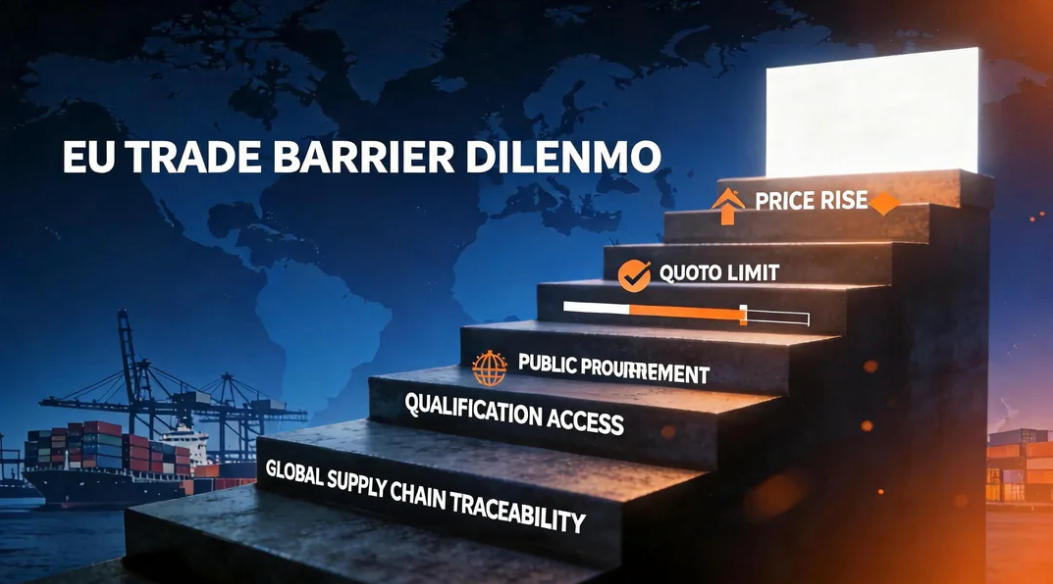
Step 1: Tariffs — Make Imports More Expensive
The most familiar trade barrier is the tariff.
A tariff increases the landed cost of imported goods and can change the economics of a supply chain.
For importers, the calculation is relatively straightforward:
Product Cost + Freight + Duty + Other Import Costs = Landed Cost
When tariffs increase, companies may:
- Raise selling prices
- Reduce margins
- Change suppliers
- Move production
- Increase local manufacturing
- Search for alternative sourcing countries
Tariffs therefore change price competitiveness.
But Europe is increasingly looking beyond price.
Step 2: Quotas — Control How Much Can Enter
The next layer is more restrictive.
Instead of simply saying:
“You can import this product, but pay a higher tariff.”
A government can effectively say:
“You can import only a certain amount under specified conditions.”
That is where quotas and safeguard measures become important.
In September, EU countries led by France and Italy, with Germany also expected to support the effort, began seeking safeguard measures covering certain chemical and plastic imports, including products such as PET, epoxy resins and glass fibres. The proposed measures could include both quotas and tariffs.
For logistics companies and importers, quotas create a different problem.
A tariff primarily changes cost.
A quota can change availability.
That means companies may need to think about:
- Import timing
- Allocation
- Annual volumes
- Customs classification
- Supplier diversification
- Alternative production locations
- Inventory buffers
The question becomes not only:
“How much will it cost?”
but:
“Will we still have access to the market at the required volume?”
Step 3: Public Procurement — The Market Can Be Closed Before Customs
This is where the concept of market access becomes much more interesting.
On September 9, the European Commission proposed a major overhaul of EU public procurement rules.
The proposal is designed to strengthen European competitiveness and reduce foreign dependencies. It would allow clearer preferences for bids with European content and place greater emphasis on supply-chain resilience, cybersecurity and strategic considerations.
EU public procurement represents roughly €2.5 trillion, or around 15% of EU GDP.
That is a huge market.
And unlike a tariff, a procurement restriction can work differently.
A Chinese supplier may be able to import its product into Europe.
But that does not necessarily mean it can compete for every European government contract.
This creates a new type of trade barrier:
The product can enter the market — but the supplier may not be eligible for the most valuable projects.
For manufacturers of construction materials, electrical equipment, machinery, transportation equipment, medical products and infrastructure-related goods, this distinction could become increasingly important.
Step 4: Supply-Chain Restrictions — The Most Strategic Layer
The fourth layer goes beyond the product itself.
It asks:
Where does this product actually come from?
And increasingly:
Who controls the supply chain behind it?
Europe is placing greater emphasis on strategic dependencies.
That includes:
- Critical raw materials
- Rare earths
- Semiconductors
- Batteries
- Energy technologies
- Industrial components
- Cybersecurity-sensitive equipment
- Strategic infrastructure
The EU-China trade discussion is therefore no longer only about whether Chinese goods are “too cheap.”
It is increasingly about whether Europe is becoming too dependent on a foreign supply chain.
This changes the nature of customs and logistics.
The Importer May Need to Prove More Than Country of Origin
For years, an importer could focus heavily on:
HS Code + Country of Origin + Customs Value
That remains essential.
But the emerging environment requires a broader supply-chain picture.
For some products, companies may need to understand:
Who manufactured the components?
Where were they substantially transformed?
Where is the final assembly performed?
Which company controls the supplier?
Does the product contain strategically sensitive materials?
Is the supplier subject to specific EU trade restrictions?
This is particularly important when companies begin moving production from China to Vietnam, Malaysia, Thailand, Mexico or other countries.
Changing the shipping route does not automatically change the country of origin.
And changing the final assembly location does not automatically eliminate trade-defense exposure.
For logistics companies, origin management and documentation are becoming part of supply-chain strategy.
From “Shipping Cost” to “Market Access Cost”
This may be the biggest lesson for importers.
Traditionally, logistics decisions focused on:
Freight + Duty + Delivery
But the new environment is increasingly:
Freight + Duty + Quota Risk + Compliance + Origin Risk + Market Access
Consider a hypothetical importer.
It may find a Chinese factory that offers the lowest FOB price.
But if the product later faces:
- Additional tariffs
- A safeguard quota
- Anti-dumping duties
- Procurement restrictions
- Origin scrutiny
- New regulatory requirements
the original “cheap supplier” may no longer be the cheapest supply-chain option.
The correct calculation is the total landed and compliance-adjusted cost.
This Is Why Supply-Chain Diversification Is Accelerating
The response from businesses is unlikely to be simply:
“Stop buying from China.”
That is often unrealistic.
China remains deeply integrated into global manufacturing networks.
Instead, companies may build multi-country supply chains:
China + Vietnam
China + India
China + Mexico
China + Europe
The objective is not necessarily to eliminate China.
It is to create alternatives.
For example:
China may remain the primary source for components and machinery.
Vietnam may handle selected assembly operations.
Mexico may serve North American customers.
Europe may handle final manufacturing or distribution for certain strategic products.
This creates a more complicated but potentially more resilient network.
The Trade Barrier Is Moving Upstream
This is the key point logistics professionals should watch.
The traditional trade barrier was located at the border:
Container arrives → Customs calculates duty → Cargo is released.
The emerging trade barrier can appear much earlier:
Supplier selection → Manufacturing location → Component sourcing → Origin determination → Procurement eligibility → Customs → Final delivery
In other words:
Trade policy is moving upstream into supply-chain design.
That is why logistics, customs and sourcing decisions are increasingly connected.
What Should Importers Do Now?
Companies selling into the EU should not wait until October to review their supply chains.
At minimum, importers should evaluate:
- Product exposure
Identify products that could face tariffs, anti-dumping measures, safeguards or quotas.
- Origin exposure
Understand where the product and its major components actually originate.
- Supplier concentration
Determine how dependent the business is on one country or one supplier.
- Procurement exposure
If your customers include governments, infrastructure operators or publicly funded institutions, examine whether future procurement rules could affect eligibility.
- Alternative sourcing
Develop realistic alternatives rather than simply searching for another country on paper.
- Logistics flexibility
Consider multiple ports, shipping routes, consolidation locations and regional warehouses.
- Inventory strategy
If quotas or trade measures become possible, inventory positioning can become a competitive advantage.
The Bigger Picture
The EU-China relationship is entering a different phase.
The question is no longer simply:
“Will Europe impose tariffs on Chinese products?”
It is becoming:
“Under what conditions will Chinese products and companies have access to the European market?”
That is a much bigger question.
Tariffs affect price.
Quotas affect volume.
Public procurement rules affect eligibility.
Supply-chain restrictions affect the structure of production itself.
Together, these measures create a much broader concept of market access.
And that may be the most important trade-policy trend for European importers to watch.
The New Trade Barrier May Not Be a Tariff.
It May Be Market Access.
For logistics companies, this means the future role is not simply moving cargo from China to Europe.
It is helping businesses understand how products, suppliers, origins, routes and compliance requirements fit together.
Because in the next phase of global trade, the most important question may not be:
“Can we ship it to Europe?”
It may be:
“Can we still access the European market once it gets there?”