
One of the most common questions freight forwarders hear is:
“My cargo only weighs 100 kg. Why is the shipping cost so high?”
For many importers, this seems confusing.
After all, freight costs should be based on weight, right?
Not always.
In international logistics, especially air freight, carriers are not only selling weight capacity.
They are also selling space.
And sometimes, space is more valuable than weight.
That’s why a lightweight shipment can still generate a surprisingly high freight bill.
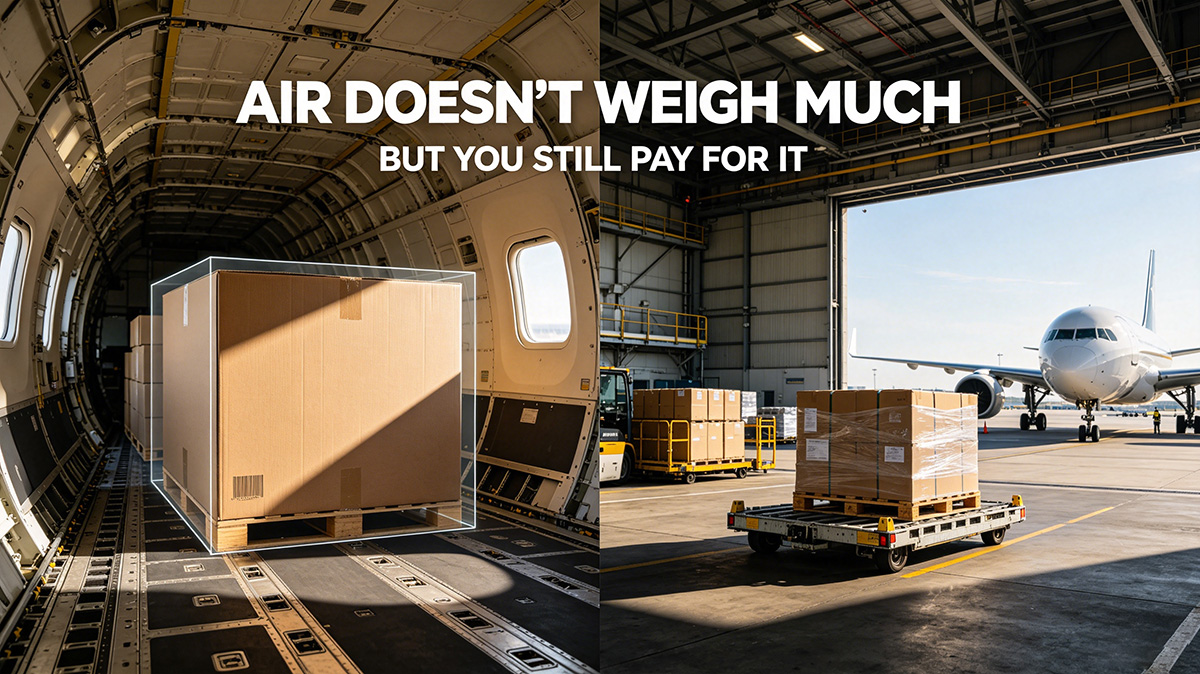
The Hidden Factor: Volumetric Weight
Airlines have a limited amount of space available on every aircraft.
A shipment may be light, but if it occupies a large amount of space, it prevents other cargo from being loaded.
To account for this, airlines use a concept called:
Volumetric Weight (Dimensional Weight)
This calculation estimates how much space a shipment consumes rather than how much it physically weighs.
In simple terms:
A large, lightweight shipment may be charged as if it weighs much more than it actually does.
Why Airlines Charge for Space
Imagine two shipments.
Shipment A
- Actual Weight: 500 kg
- Compact packaging
- Small footprint
Shipment B
- Actual Weight: 100 kg
- Large cartons
- Five times more space occupied
Which shipment creates a bigger challenge for the airline?
Often, Shipment B.
Even though it weighs less, it consumes far more cargo space.
The aircraft cannot fill that space with other revenue-generating shipments.
As a result, carriers charge based on whichever is greater:
- Actual Weight
- Volumetric Weight
Products Commonly Affected by Volumetric Weight
Many importers are surprised when products that feel “light” become expensive to ship.
Common examples include:
- Furniture
- Pillows and cushions
- Plastic products
- Toys
- Lamps and lighting fixtures
- Home décor items
- Sporting goods
- Display materials
- Packaging products
These items often occupy large volumes relative to their actual weight.
A Simple Example
Imagine shipping cartons containing decorative pillows.
Actual cargo weight:
100 kg
Volumetric weight:
300 kg
Because the shipment occupies the equivalent space of 300 kg of cargo, the airline may calculate charges using 300 kg instead of 100 kg.
This is why freight costs sometimes appear much higher than expected.
How Importers Can Reduce Air Freight Costs
The good news is that volumetric weight can often be managed.
Optimize Packaging
Reducing carton dimensions by even a few centimeters can significantly lower chargeable weight.
Eliminate Empty Space
Many shipments contain unnecessary air inside cartons.
Improved packing methods can reduce wasted volume.
Use Compressible Packaging When Possible
Products such as textiles, cushions, and soft goods may benefit from vacuum packing or compression techniques.
Consider Alternative Shipping Methods
For large but lightweight products, ocean freight may provide a more economical solution.
Plan Early
When transit time allows, choosing a slower transportation method can reduce overall logistics costs.
Weight Isn’t the Whole Story
Many importers focus entirely on kilograms when estimating shipping expenses.
However, transportation providers must balance both:
- Weight capacity
- Space capacity
The cargo that occupies the aircraft is often just as important as the cargo that weighs down the aircraft.
This is why two shipments with the same weight can have very different freight costs.
Final Thoughts
In air freight, you’re not only paying for weight.
You’re also paying for space.
A shipment may be lightweight, but if it occupies a large amount of room, transportation costs can increase significantly.
Understanding volumetric weight helps importers make better packaging decisions, estimate costs more accurately, and avoid unpleasant surprises when requesting freight quotes.
Because in logistics, air may not weigh much—but you still pay for it.