
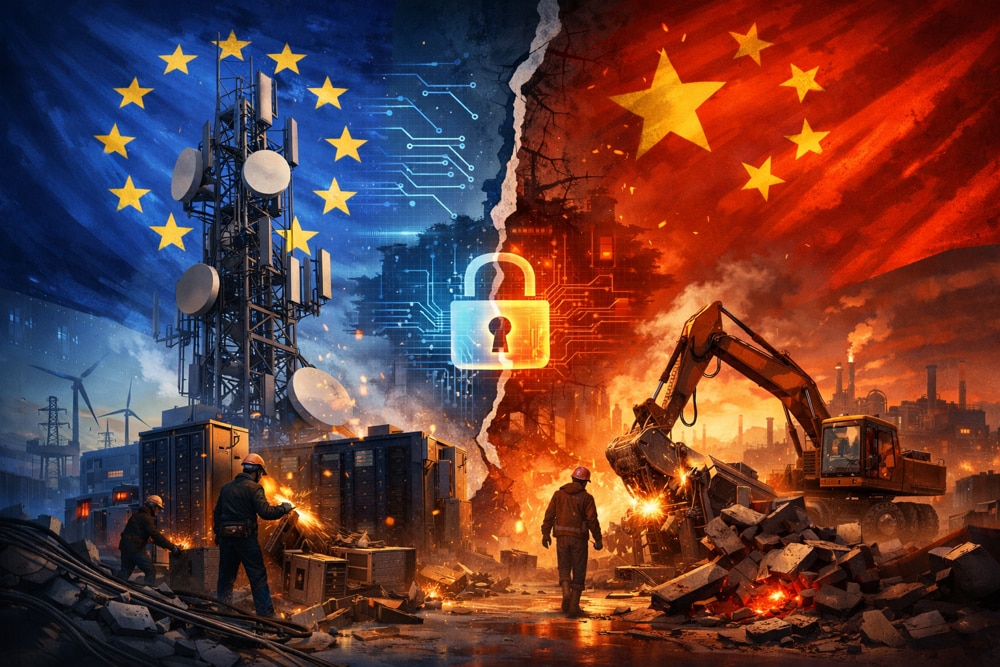
The European Union is reportedly moving forward with stricter cybersecurity legislation that could significantly limit the participation of Chinese companies in critical infrastructure projects across Europe.
According to a joint report by the China Chamber of Commerce to the EU and KPMG, the proposed measures may require the gradual removal and replacement of large amounts of Chinese hardware from sectors considered strategically sensitive. The estimated replacement cost could exceed €367.8 billion over the next five years.
The proposal reflects a broader shift taking place not only in Europe, but globally:
Security considerations are increasingly shaping trade and industrial policy.
From Cost Efficiency to Supply Chain Security
For decades, globalization was primarily driven by economics. Governments and companies focused on:
- Lower production costs
- Faster manufacturing
- Efficient international supply chains
Today, the equation is changing.
Critical sectors such as:
- Telecommunications
- Energy grids
- Cloud infrastructure
- Artificial intelligence
- Ports and logistics
- Data centers
are now viewed through a national security lens.
European policymakers argue that reducing dependence on foreign suppliers in strategic industries is necessary to improve long-term resilience and cybersecurity.
This approach is not unique to Europe.
The United States has introduced similar restrictions on telecommunications equipment and semiconductor technologies, while other regions are also reviewing foreign involvement in sensitive infrastructure.
Europe Faces a Difficult Balance
At the same time, Europe’s relationship with Chinese manufacturing remains deeply interconnected.
Chinese suppliers continue to play a major role in:
- Renewable energy systems
- Electronics manufacturing
- Industrial machinery
- Battery supply chains
- Telecommunications equipment
Replacing existing systems could involve:
- Large financial costs
- Multi-year transition periods
- Operational disruptions
- Higher infrastructure expenses for European businesses and consumers
This creates a policy dilemma.
On one side, governments seek greater technological independence and supply chain security.
On the other, many industries remain heavily reliant on China’s manufacturing scale, pricing, and mature industrial ecosystem.
Potential Impact on Global Trade
If stricter regulations are implemented, the effects may extend beyond Europe’s technology sector.
Several long-term trends could accelerate:
- Supply Chain Regionalization
Companies may increasingly divide operations into separate regional systems:
- China-focused supply chains
- Western-aligned supply chains
- Regional manufacturing hubs
This could reshape global trade flows over the next decade.
- More Overseas Manufacturing by Chinese Firms
To reduce political and regulatory risks, more Chinese companies may expand:
- Local assembly operations
- Joint ventures
- Manufacturing facilities in Europe or third countries
This trend is already visible in sectors such as electric vehicles, batteries, and solar energy.
- Rising Infrastructure Costs
Restricting existing suppliers may improve perceived security in some areas, but could also increase:
- Equipment costs
- Construction timelines
- Energy transition expenses
- Consumer prices
The long-term economic impact will depend on how quickly alternative suppliers can scale production.
A New Phase of Globalization
The debate surrounding Chinese technology in Europe highlights a broader transformation in the global economy.
The era of globalization driven mainly by cost optimization is gradually evolving into one shaped by:
- Security
- Strategic resilience
- Technological sovereignty
- Political alignment
This does not necessarily mean a complete economic separation between China and Europe.
However, it does suggest that future international trade may become increasingly influenced by geopolitical considerations rather than purely commercial ones.
For global manufacturers, logistics providers, and exporters, adapting to this new environment may become just as important as managing costs and efficiency.