
For many importers, reducing costs is always a priority. Freight costs, product prices, and import duties all affect profit margins, especially in highly competitive industries.
Because of this, some businesses may consider declaring a lower cargo value in order to reduce import duties.
At first glance, the logic seems simple:
“If I can save a few hundred dollars in duties, my overall costs go down.”
However, what appears to be a short-term saving can sometimes become a much larger and more expensive problem later.
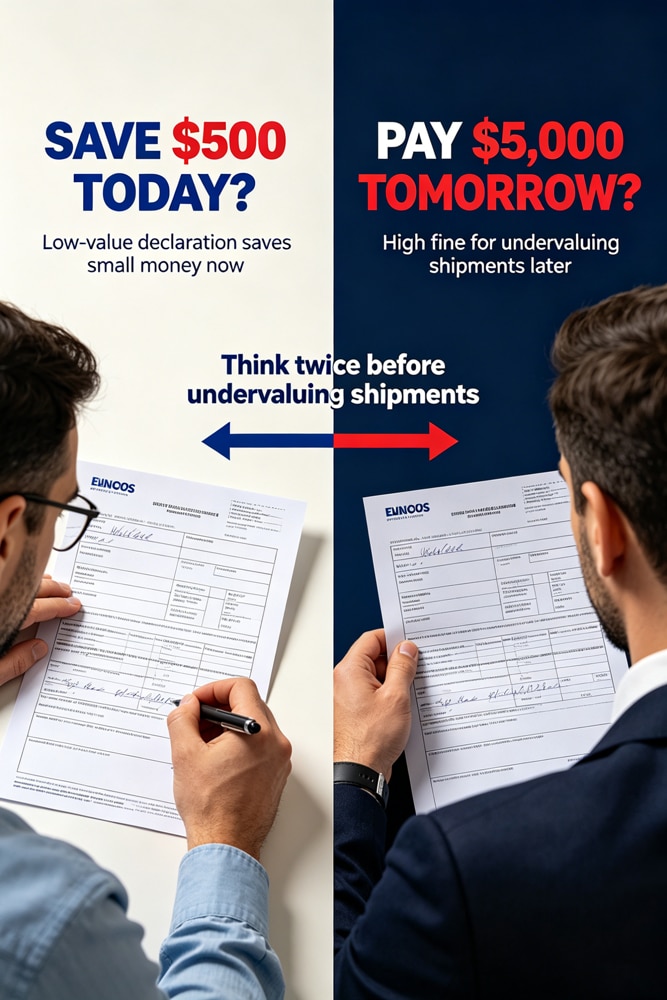
Why Some Importers Undervalue Shipments
Undervaluation occurs when the declared value on shipping or customs documents is intentionally lower than the actual value of the goods.
Businesses may do this to:
- Reduce import duties and taxes
- Lower overall landed costs
- Improve profit margins
- Stay competitive in pricing
For example:
If the actual cargo value is $20,000 but the declared value is listed as $8,000, the importer may initially save several hundred dollars in duties.
But customs authorities are not relying solely on the invoice amount.
How Customs Authorities Evaluate Shipments
Many importers assume customs only reviews the documents provided. In reality, customs systems often compare multiple data points, including:
- Product category
- Historical shipment records
- Market pricing information
- Supplier details
- Country of origin
- Similar imported products
If the declared value appears significantly different from expected market value, the shipment may attract additional attention.
For example:
A shipment of branded kitchen products, furniture, or electronics declared at an unusually low value may trigger questions during customs review.
What Can Happen if the Declared Value Raises Concerns?
The immediate duty savings may be small, but the downstream consequences can be much larger.
Possible outcomes include:
Cargo inspections
Customs may select the shipment for further examination, increasing transit time and creating delays.
Additional documentation requests
Importers may be required to provide:
- Purchase contracts
- Payment records
- Supplier invoices
- Banking documentation
Duty reassessment
Customs authorities may determine a different value and recalculate taxes and duties.
Fines and penalties
If authorities conclude that information was intentionally misrepresented, financial penalties may apply.
Increased scrutiny on future shipments
Repeated issues can lead to a higher likelihood of future inspections.
The Real Cost Is Often Not the Duty Difference
Many businesses focus only on the money saved today.
For example:
Saved on duties:
$500
Potential additional costs:
- Storage fees
- Inspection fees
- Delayed inventory
- Penalties
- Customer fulfillment delays
- Lost sales opportunities
Suddenly, the “saving” can become several thousand dollars.
This is why experienced importers often focus on supply chain stability rather than only reducing one cost category.
Better Ways to Reduce Import Costs
Rather than creating risk through inaccurate declarations, businesses can lower costs through more sustainable methods:
- Optimize packaging dimensions
- Reduce unnecessary shipping volume
- Plan shipments earlier
- Consolidate cargo
- Choose appropriate shipping methods
- Review tariff classifications carefully
- Work with experienced freight and customs professionals
These methods can reduce costs without increasing compliance risk.
Final Thoughts
Successful importing is not simply about paying less today.
It is about creating a process that is reliable, compliant, and predictable.
A few hundred dollars saved on duties may seem attractive in the short term, but unexpected inspections, penalties, and delays can quickly outweigh those savings.
Sometimes the most expensive mistakes are the ones that initially looked like the cheapest option.