
The Trans-Pacific ocean freight market is entering the second half of August with another round of rate increases.
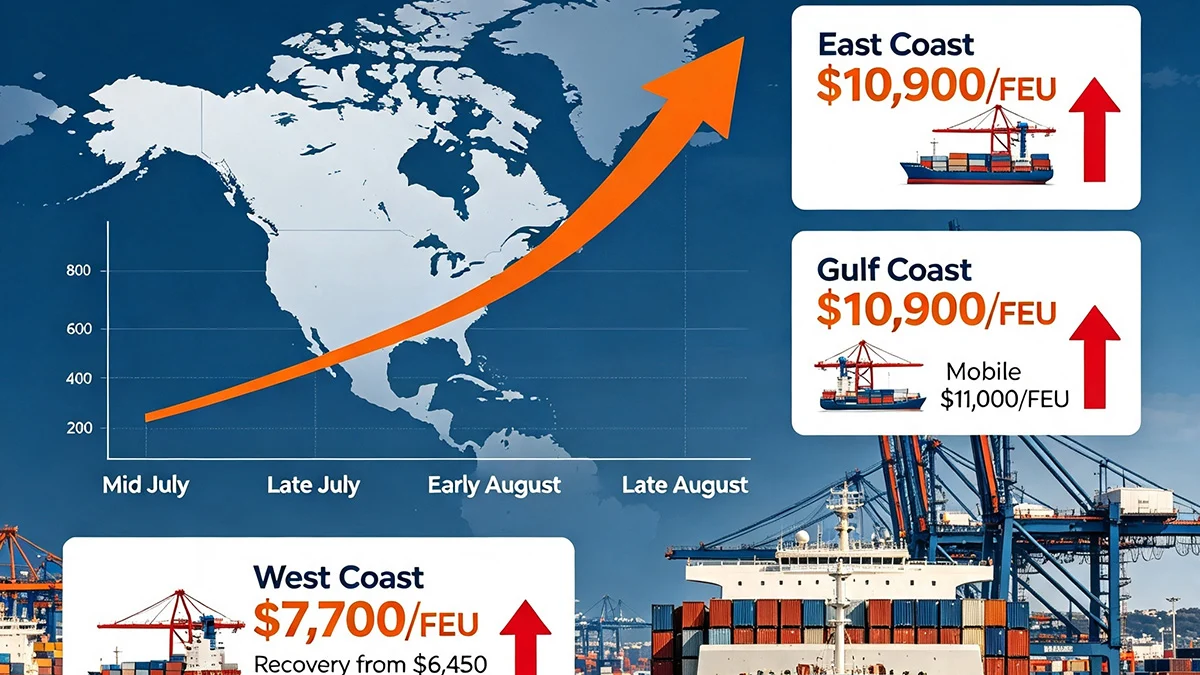
New FAK rates effective August 15–31, 2026 show that carriers continue to maintain their rate restoration strategy, with most major U.S. routes increasing by USD 300–400 per FEU compared with the previous rate period.
Key Rate Changes
| Route | Aug. 1–14 | Aug. 15–31 | Change |
| U.S. West Coast | $7,300 | $7,700 | +$400 |
| U.S. East Coast | $10,500 | $10,900 | +$400 |
| U.S. Gulf | $10,600 | $10,900 | +$300 |
| Mobile | $10,700 | $11,000 | +$300 |
| PS Chicago | $9,150 | $9,550 | +$400 |
| PRR Chicago | $8,850 | $9,250 | +$400 |
| VAN Chicago | $8,950 | $9,350 | +$400 |
| Vancouver / PRR | $7,500 | $7,700 | +$200 |
| Toronto / Montreal | $9,100 | $9,300 | +$200 |
The increases are not as dramatic as the adjustment seen at the beginning of August, but the direction remains clearly upward.
- Carriers Continue to Defend Higher Rates
The most important signal from the latest update is that carriers are continuing to push rates higher rather than allowing the July correction to continue.
In July, the U.S. West Coast market experienced a significant adjustment. However, rates subsequently recovered, reaching $7,700/FEU for the second half of August.
This suggests that carriers remain confident in maintaining higher market levels.
- U.S. East Coast and Gulf Rates Remain Extremely High
The East Coast and Gulf markets continue to command the highest rates.
For August 15–31:
- U.S. East Coast: $10,900/FEU
- U.S. Gulf: $10,900/FEU
- Mobile: $11,000/FEU
This is an important consideration for importers because the difference between West Coast and East Coast transportation costs remains substantial.
For cargo that can be routed through different gateways, importers may benefit from comparing total landed logistics costs rather than looking only at the ocean freight component.
- Inland Rates Are Also Moving Higher
The increase is not limited to port-to-port transportation.
IPI rates to major inland destinations have also increased:
- PS Chicago: $9,550/FEU
- PRR Chicago: $9,250/FEU
- VAN Chicago: $9,350/FEU
This means importers shipping to inland distribution centers need to consider the entire transportation chain when evaluating freight costs.
A lower ocean rate does not necessarily mean a lower total logistics cost if inland transportation is significantly more expensive.
- Canada Rates Are Rising More Moderately
Canadian routes have also increased, although the adjustment is smaller than on major U.S. routes.
Vancouver / Prince Rupert is now $7,700/FEU, while Toronto and Montreal via Vancouver or Prince Rupert are around $9,300/FEU.
Compared with the previous period, the increases are approximately $200/FEU.
- Lightweight Cargo Has an Important Advantage
The latest rate authorization also includes special discounts for certain East Coast shipments.
For qualifying cargo moving through BOS/BAL:
- Cargo ≤10 tons/FEU: $500/FEU discount
- Cargo ≤8 tons/FEU: $700/FEU discount
For importers shipping relatively lightweight cargo, these special rates could significantly reduce the effective freight cost.
What Does This Mean for Importers?
The current market should be viewed as a high-rate environment with continued upward pressure, rather than simply another short-term spike.
Importers should avoid making decisions based solely on the headline FAK rate.
Instead, consider:
- Total landed transportation cost
- Port and inland routing
- Carrier options
- Available vessel space
- Transit time
- Cargo weight and volume
- Potential promotional or special rates
For flexible shipments, checking multiple carriers and routing options can sometimes create meaningful savings.
What Should Importers Do Now?
If you have shipments planned for late August or early September, it is worth monitoring the market closely.
Instead of waiting until the last minute, importers can:
- Request updated rates before production is completed.
- Compare West Coast, East Coast, and Gulf options.
- Check for temporary carrier promotions or special space.
- Evaluate ocean and inland costs together.
- Secure space early when shipment schedules are fixed.
Outlook
The latest rate increase confirms that the Trans-Pacific market remains volatile.
With U.S. East Coast and Gulf rates approaching $11,000/FEU, transportation costs remain a significant consideration for businesses importing from Asia.
The next few rate cycles will be important. If demand and vessel utilization remain strong, carriers may continue defending current price levels. However, if booking volumes weaken or additional capacity becomes available, the market could experience another correction.
For now, the safest approach for importers is not to assume that rates will automatically fall.
Monitor the market. Compare options. Plan ahead.
At TD Logistics, we monitor carrier rate changes and available promotional space to help importers evaluate competitive shipping options from China to the United States and Canada.