For years, Chinese manufacturers exporting to Europe have focused on product quality, pricing, certifications, customs clearance, and delivery times.
Now, another question is becoming increasingly important:
Can you prove how your products were made?
Europe is tightening supply-chain compliance, and labor practices are moving closer to the center of trade enforcement.
The EU Forced Labour Regulation is a major part of this shift.
The regulation was adopted in 2024, and on June 26, 2026, the European Commission launched its preparedness package, including guidance, risk information, and tools to help businesses prepare.
The regulation will become applicable on December 14, 2027. From that date, products made with forced labor will be prohibited from being placed on the EU market, made available on the EU market, or exported from the EU. The rules apply regardless of where the products are manufactured.
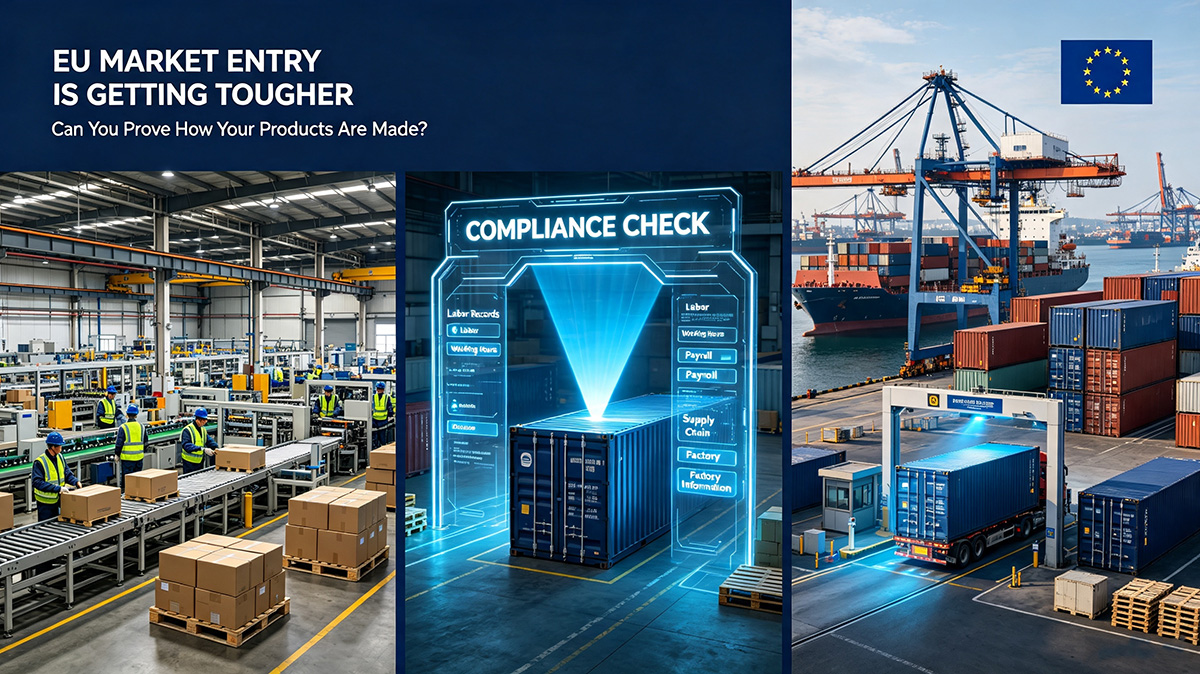
This Is More Than a Customs Issue
One common misunderstanding is that this is simply another document required at customs.
It isn’t.
The core issue is supply-chain traceability and forced-labor risk.
European authorities can investigate suspected forced labor, while customs authorities can play a role in identifying and stopping products at the EU border. If forced labor is confirmed, the relevant products can be prohibited from the EU market and may have to be withdrawn or otherwise dealt with under applicable rules.
That means the question for Chinese manufacturers is no longer only:
“Can I produce this product at the right price?”
It increasingly becomes:
“Can I demonstrate that this product was manufactured through a compliant and transparent supply chain?”
What Kind of Evidence Could Matter?
The EU regulation does not prescribe one universal checklist saying that every Chinese factory must submit attendance records, social-security records, or a specific set of HR documents.
However, during an investigation, companies may be asked to provide information about how they address forced-labor risks in their supply chains.
For manufacturers, that makes internal documentation increasingly important.
Depending on the circumstances, businesses may need to be able to explain and substantiate issues such as:
- Who actually manufactures the products
- Where production takes place
- Who the workers are employed by
- How working hours are managed
- How wages are paid
- Whether workers can freely leave employment
- How recruitment is conducted
- Whether subcontractors are involved
- How labor risks are monitored across suppliers
- What corrective actions are taken when risks are identified
Records such as employment documentation, payroll information, working-hour records, supplier information, and other relevant evidence can therefore become important parts of a company’s compliance system.
The key is not simply having paperwork.
The key is having credible, consistent, and traceable evidence.
Why European Buyers Are Paying More Attention
The pressure does not necessarily start with customs.
In many cases, it may start with the European buyer.
European importers, brands, retailers, and distributors have increasing incentives to understand where their products come from and how their supply chains operate.
If a European customer asks a Chinese supplier questions about its factory, workers, subcontractors, or production process, the supplier should not automatically assume that the customer is creating unnecessary bureaucracy.
The buyer may simply be trying to manage its own regulatory and reputational risk.
The European Commission has also created a risk database covering products and geographical areas where forced-labor risks have been documented based on credible, independent, and verifiable sources. This information can be used by businesses and authorities when assessing potential risks.
Small and Medium-Sized Manufacturers Should Not Ignore This
Large manufacturers may already have dedicated compliance teams, HR systems, supplier-audit programs, and document-management procedures.
Smaller factories may not.
For an SME that has relied mainly on informal employment management, undocumented subcontracting, or fragmented supplier records, the coming changes could create a very different business environment.
A European customer may eventually ask:
“Who made this product?”
Then:
“Where was it made?”
And finally:
“Can you prove it?”
If the answer is unclear, the problem may go far beyond paperwork.
It could affect customer confidence, supplier qualification, business relationships, and access to the European market.
The Biggest Risk May Be Lack of Supply-Chain Visibility
A factory may have excellent products and competitive prices but still face problems if it cannot clearly identify its upstream suppliers.
For example:
Factory → Subcontractor → Raw Material Supplier → Component Supplier
If one critical stage is hidden or poorly documented, the manufacturer may struggle to demonstrate that its supply chain is free from forced-labor risks.
This is why supply-chain visibility is becoming increasingly important.
Companies should know:
Who makes it.
Where it is made.
Who supplies the materials.
Who handles production.
What records exist.
And whether the information can be verified.
What Should Chinese Exporters Do Now?
The good news is that enforcement of the EU Forced Labour Regulation does not begin until December 14, 2027.
That means businesses still have time to prepare. The European Commission itself describes the current period as preparation time and has already released guidance and tools for businesses.
Chinese manufacturers exporting to Europe should consider taking several practical steps now:
- Map the Supply Chain
Identify factories, subcontractors, raw-material suppliers, and other critical production partners.
- Strengthen Labor Documentation
Maintain reliable records relating to employment, wages, working hours, recruitment, and other relevant labor practices.
- Control Subcontracting
Know whether production is being transferred to another factory without the buyer’s knowledge.
- Keep Evidence Consistent
Different documents should tell the same story.
Supplier information, production records, payroll data, and commercial documents should be reasonably consistent and traceable.
- Prepare for Customer Due Diligence
European customers may increasingly ask suppliers for information about production conditions and supply-chain risks.
Being able to respond quickly can become a competitive advantage.
Compliance Could Become Part of Your Competitive Advantage
For years, Chinese manufacturing competed heavily on:
Price + Quality + Speed.
The next stage may increasingly be:
Price + Quality + Speed + Compliance.
A factory that can provide transparent and credible supply-chain information may have an advantage over a competitor that offers a slightly lower price but cannot explain how its products are manufactured.
This is particularly important for businesses selling to European brands, retailers, importers, and distributors.
The Bottom Line
The headline “No attendance records or social-security records, no entry into Europe” is too simplistic.
The real story is more important.
Europe is moving toward a supply chain where manufacturers may need to demonstrate not only what they produce, but also how and under what labor conditions those products are produced.
The EU Forced Labour Regulation will apply from December 14, 2027, and preparation has already begun.
For Chinese manufacturers, waiting until a European customer asks for evidence may be too late.
Start building the evidence chain before you need it.
Because in the next phase of global trade, compliance may not just determine whether your product is competitive.
It may determine whether your product gets access to the market at all.