
The global shipping industry is entering a period of major change.
Geopolitical tensions, disruptions around traditional maritime routes, and growing pressure to make supply chains faster and more resilient are forcing companies to reconsider how goods move around the world.
Against this backdrop, a new development is attracting significant attention: China-Europe container shipping through the Arctic’s Northern Sea Route (NSR).
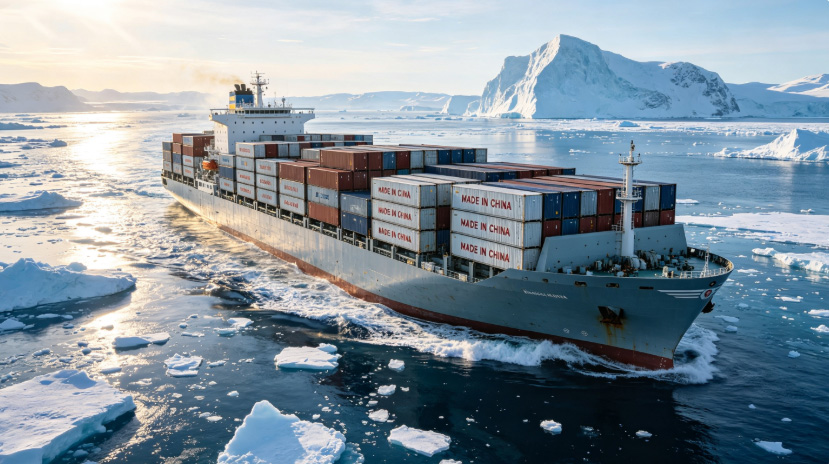
In August 2026, a container vessel departed from Ningbo, China, bound for Felixstowe in the United Kingdom through the Northern Sea Route. The voyage is expected to take roughly 20–21 days, significantly shorter than many conventional China-Europe sea routes.
This is not yet a replacement for the Suez Canal route. But it could be an important signal of where global shipping is heading.
Why Is the Arctic Route Important?
The traditional China-Europe shipping route through the Suez Canal remains one of the world’s most important trade corridors.
However, recent geopolitical disruptions have highlighted the vulnerability of relying heavily on a limited number of major shipping routes.
When a key maritime corridor becomes congested, restricted, or exposed to security risks, the consequences can spread quickly across the global supply chain.
The Northern Sea Route offers a fundamentally different option.
By traveling along Russia’s Arctic coast, vessels can significantly shorten the distance between Northeast Asia and Northern Europe.
For certain China-Europe shipments, that could translate into:
- Shorter transit times
- Lower fuel consumption
- Greater route diversification
- Faster inventory turnover
- More options for time-sensitive cargo
The potential is significant.
But there is an important distinction between shorter and cheaper.
Faster Does Not Automatically Mean Cheaper
The Northern Sea Route has a shorter geographical distance, but the economics are more complicated.
Arctic shipping can involve additional costs associated with:
- Ice-class vessels
- Ice navigation
- Insurance
- Special permits
- Seasonal operating windows
- Limited Arctic infrastructure
- Weather and ice conditions
- Emergency and rescue capabilities
Therefore, it is too early to conclude that Arctic shipping will consistently offer lower freight rates than traditional routes.
Its biggest advantage may initially be time and diversification, rather than simply price.
For importers, saving ten or more days can sometimes be more valuable than saving a small percentage on freight.
The Arctic Route Is Seasonal
Another major limitation is seasonality.
Unlike conventional China-Europe routes, the Northern Sea Route cannot currently operate with the same year-round flexibility.
Its commercial viability depends heavily on Arctic ice conditions and the available navigation window.
This means the NSR is more likely to develop initially as a seasonal alternative rather than a complete replacement for existing routes.
For logistics companies, this creates an interesting challenge.
The question will not simply be:
“Which route is cheapest?”
Instead, companies will increasingly ask:
“Which route provides the best combination of cost, transit time and risk for this particular shipment?”
Supply Chains Are Becoming Multi-Route
This may be the most important lesson from the development of Arctic shipping.
The future of global logistics is unlikely to depend on one “perfect” route.
Instead, businesses may use a portfolio of transportation options:
Suez Canal → established global route
Cape of Good Hope → alternative for certain Europe-bound cargo
Northern Sea Route → seasonal Arctic option
Rail → faster land-based alternative for selected cargo
Air Freight → premium solution for urgent shipments
This creates a more flexible supply chain.
When one route becomes disrupted, companies with multiple options can react faster.
What Could This Mean for China-Europe Trade?
If Arctic container shipping continues to develop, its impact could extend beyond transportation.
Shorter transit times could encourage European importers to reconsider inventory strategies.
For example, companies may be able to:
- Reduce safety stock
- Improve inventory turnover
- Respond faster to market demand
- Shorten replenishment cycles
- Reduce the financial cost of goods in transit
Over time, these benefits could become more important than the freight rate itself.
However, large-scale adoption will depend on whether the route can demonstrate consistent reliability, commercially competitive costs and sufficient infrastructure.
The Bigger Picture: Resilience Over Optimization
For decades, global supply chains were optimized primarily around cost.
Today, the priority is changing.
Companies increasingly want supply chains that are:
Cost-efficient + Fast + Flexible + Resilient
The Northern Sea Route is a good example of this transition.
It does not need to replace the Suez Canal to become strategically important.
It only needs to provide a reliable alternative when certain cargoes, seasons or market conditions make the Arctic route attractive.
What Should Importers Do?
Importers should not immediately switch their China-Europe shipments to the Arctic route.
Instead, they should monitor its development and evaluate it shipment by shipment.
Key factors include:
- Origin and destination ports
- Cargo type
- Required delivery time
- Seasonal timing
- Total landed cost
- Insurance requirements
- Route stability
- Customs and geopolitical considerations
The right logistics strategy may increasingly involve comparing several routes before every major shipment.
Our View
The Northern Sea Route is still in an early stage of commercial development.
There are significant challenges ahead, particularly regarding seasonality, infrastructure, operating costs and geopolitical complexity.
But its emergence is important for another reason.
It demonstrates that global shipping is moving toward a more diversified and flexible network of trade routes.
The future of logistics may not be about finding one cheapest route.
It may be about having the right route, at the right time, for the right cargo.
For importers and logistics providers, that means the ability to analyze, compare and adapt will become increasingly valuable.
The Arctic may not replace the world’s traditional shipping routes.
But it could become an important part of the next generation of global trade.