
The U.S.-China trade relationship may be facing another tariff adjustment.
According to recent reports, the Trump administration is preparing to impose an additional 7.5% tariff on Chinese goods, citing concerns over China’s structural excess manufacturing capacity. If implemented, the additional duty would bring the relevant U.S. tariff level on Chinese imports to approximately 20%.
However, it is important to note that the 7.5% rate is not yet a universally effective new tariff. The measure is being reported as a planned or proposed action, and the final scope, timing, exemptions and implementation details remain subject to the U.S. government’s process.
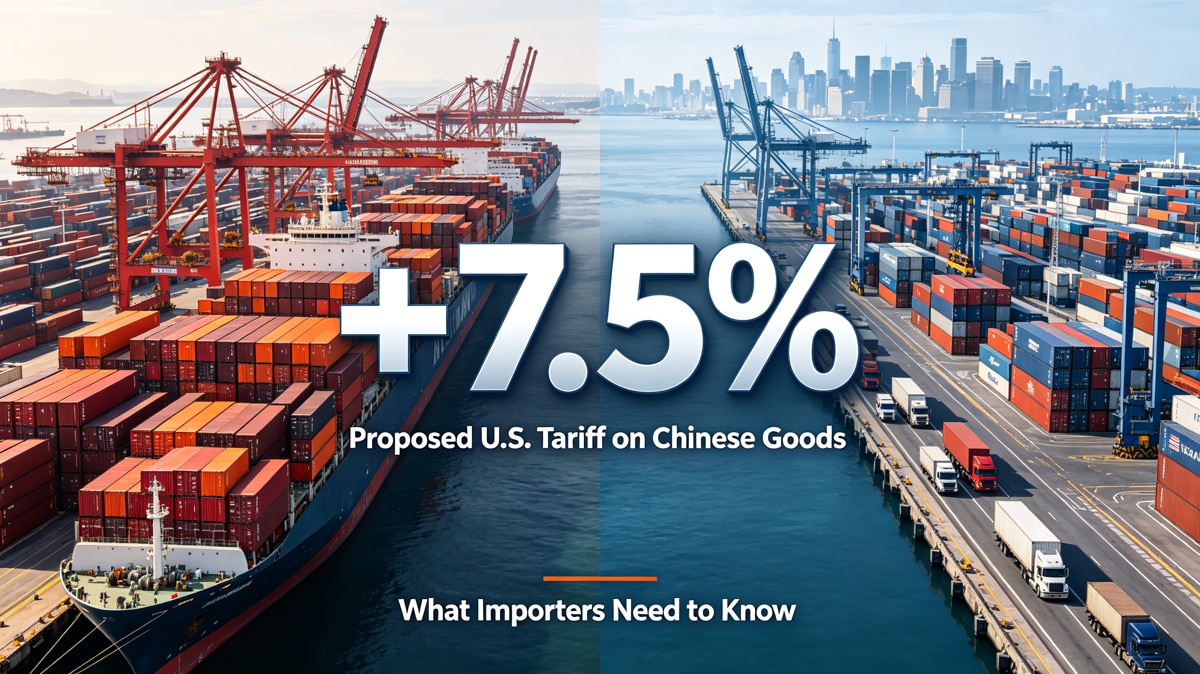
Why Is the U.S. Considering Another 7.5%?
The proposed tariff is linked to a Section 301 investigation into structural excess capacity and manufacturing production.
In March 2026, the Office of the U.S. Trade Representative (USTR) initiated Section 301 investigations into several economies, including China, to examine whether government policies and practices contributing to structural excess capacity are unreasonable or discriminatory and whether they burden or restrict U.S. commerce.
Section 301 of the Trade Act of 1974 gives the U.S. government a mechanism to investigate and respond to certain foreign practices considered unfair and harmful to U.S. commerce.
This means the proposed 7.5% tariff is different in origin from simply increasing an existing tariff rate. It is being connected to a specific trade investigation focused on excess manufacturing capacity.
Why Does the Timing Matter?
The timing is particularly significant.
Reports about the proposed tariff emerged just weeks before a planned meeting between President Donald Trump and Chinese President Xi Jinping. At the same time, Washington and Beijing are attempting to maintain a fragile trade truce.
That creates two competing possibilities.
On one hand, the tariff could increase pressure on China ahead of negotiations.
On the other hand, keeping the proposed rate at 7.5% rather than introducing a much larger increase could leave room for further negotiations.
In other words, the tariff may be both a trade policy instrument and a negotiating tool.
What Could This Mean for U.S. Importers?
For American companies sourcing products from China, another tariff increase means landed cost calculations need to be reviewed carefully.
A tariff increase does not necessarily mean that Chinese suppliers will absorb the entire additional cost.
The economic impact may be shared among:
- U.S. importers
- Chinese manufacturers
- distributors and retailers
- American consumers
- alternative suppliers in other countries
The actual impact will depend heavily on the product category, supplier pricing, profit margins and availability of alternative sources.
For importers operating on tight margins, even a 7.5-percentage-point increase can materially change the economics of a shipment.
Will This Push Manufacturing Away From China?
Possibly—but probably not overnight.
Higher tariffs can encourage companies to diversify sourcing through a China+1 strategy.
That could mean increasing procurement or final assembly in countries such as Vietnam, India, Mexico and other manufacturing hubs.
But changing the country of origin is not as simple as moving a factory.
Modern manufacturing depends on:
suppliers + components + tooling + engineering + labor + production capacity + logistics + ports + warehousing
China remains deeply integrated into many of these supply chains.
As a result, higher U.S. tariffs may change where goods enter the United States without immediately eliminating China’s role as an upstream manufacturing hub.
What Should Importers Do Now?
The most important thing is not to panic—but to prepare.
- Review your tariff exposure
Identify which products may be affected and determine the current tariff classification and applicable trade measures.
- Calculate your landed cost
Don’t look only at the ocean freight rate.
Your real cost includes:
Product Cost + Duty + Freight + Customs Fees + Inland Transportation + Other Import Costs
- Talk to your suppliers
Ask whether your supplier can adjust pricing, production location or packaging to reduce the impact of additional duties.
- Consider China+1 sourcing
For larger importers, alternative production locations may become increasingly important.
However, any change in country of origin must comply with U.S. customs rules. Simply routing Chinese goods through another country does not automatically change their origin.
- Plan shipments earlier
When tariff policy is changing, shipment timing can become an important part of supply-chain planning.
Importers should monitor the final implementation date, product exclusions and customs guidance before making major purchasing decisions.
The Bigger Picture
The proposed 7.5% tariff is more than another percentage added to an import invoice.
It is another sign that U.S.-China trade is moving toward a more complex tariff and supply-chain environment.
For importers, the question is no longer simply:
“What is the ocean freight rate?”
It is increasingly:
“What will my total landed cost be when the goods arrive in the United States?”
Tariffs, sourcing strategy, transportation costs and customs compliance are becoming increasingly interconnected.
For companies importing from China, understanding the entire supply chain—not just the freight rate—will be critical to staying competitive.
Note: The 7.5% measure discussed above is based on current reports and should not be treated as a final, universally applicable tariff until the U.S. government publishes the final implementation details.