
The latest September 1–14 FAK rates provide another important signal for the Trans-Pacific shipping market:
Freight rates are still moving upward.
After a sharp correction in July, rates have recovered rapidly through August and are now reaching even higher levels in early September.
The Numbers Tell the Story
Looking at the recent rate cycles:
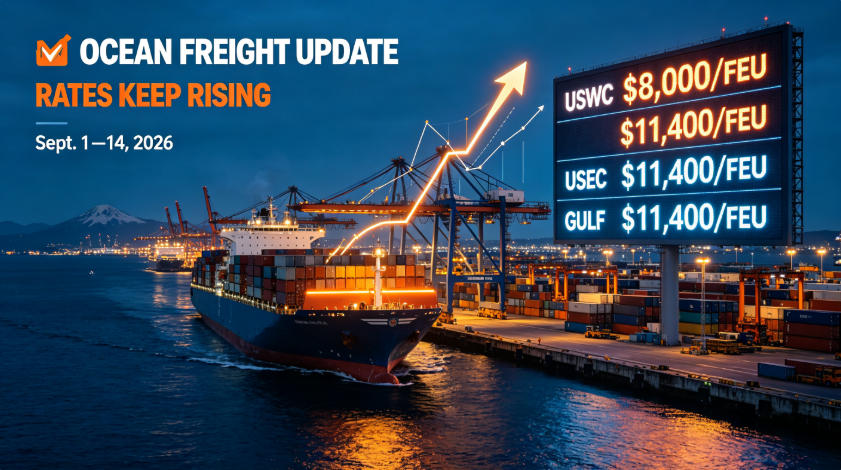
U.S. West Coast
July: approximately $6,450/FEU
August: $7,300 → $7,700/FEU
September: $8,000/FEU
U.S. East Coast
July: approximately $8,950/FEU
August: $10,500 → $10,900/FEU
September: $11,400/FEU
The direction is clear: the July correction has been completely reversed, and the market has moved to a significantly higher pricing level.
What Is Driving the Increase?
- Carriers Are Successfully Restoring Rates
One of the clearest signals is the consistency of carrier pricing.
Rather than allowing the July correction to continue, carriers have repeatedly introduced higher FAK levels.
This indicates that shipping lines are actively defending higher freight rates and attempting to maintain pricing discipline.
- Peak-Season Demand Remains Important
The third quarter is traditionally an important period for North American importers.
Retailers and wholesalers are preparing inventory for:
- Back-to-school demand
- Halloween
- Thanksgiving
- Black Friday
- Christmas
For many importers, waiting until demand peaks can mean paying significantly more for transportation.
- East Coast and Gulf Routes Remain Particularly Strong
The latest numbers are especially striking on the East Coast and Gulf Coast.
Both are now around $11,400/FEU, with Mobile reaching $11,500/FEU.
This means the cost difference between West Coast and East Coast services remains significant.
For importers with flexible distribution networks, it may be worth comparing different gateways and inland transportation options rather than automatically choosing the traditional route.
- Inland Freight Cannot Be Ignored
The increase is also visible in IPI pricing.
For example:
- PS Chicago: $9,900/FEU
- PRR Chicago: $9,600/FEU
- VAN Chicago: $9,700/FEU
Therefore, the real transportation cost should be evaluated on a door-to-door basis, not simply by comparing port-to-port ocean rates.
Does This Mean Rates Will Keep Rising?
Not necessarily.
This is an important distinction.
The current market shows strong upward pressure, but freight rates are ultimately determined by the balance between cargo demand and available capacity.
If demand remains strong and vessel utilization stays high, carriers may continue to defend current levels.
However, if demand weakens or additional capacity enters the market, another correction could occur.
Therefore, predicting a specific future rate would be premature.
What Should Importers Do?
The current environment favors planning rather than waiting.
For shipments scheduled for September and October, importers should consider:
Check rates early.
Don’t wait until cargo is ready if the shipping schedule is already known.
Compare gateways.
West Coast, East Coast, Gulf and inland routing can produce very different total costs.
Compare carriers.
FAK is a useful market benchmark, but actual booking rates can vary by carrier, sailing and space availability.
Ask about temporary promotions.
Carriers occasionally release limited-time promotional space or special rates. These opportunities can disappear quickly.
Calculate the total landed logistics cost.
The cheapest ocean rate is not always the cheapest overall solution.
Our View
The most important lesson from the past several months is how quickly the freight market can change.
The market moved from a significant July correction to another round of rate increases within a short period.
For importers, the key is not to predict the exact bottom or top of the market.
Instead, maintain visibility on freight rates, keep routing options flexible, and make booking decisions based on the overall cost and shipment schedule.
In a volatile freight market, information and timing can be just as valuable as the freight rate itself.
TD Logistics will continue monitoring carrier pricing and market developments across China–USA and China–Canada routes and sharing practical updates with importers.