China is one of the world’s largest manufacturing and sourcing markets, but there is one mistake many international buyers make:
They think China is one giant factory.
It isn’t.
China’s manufacturing industry is organized around specialized industrial clusters.
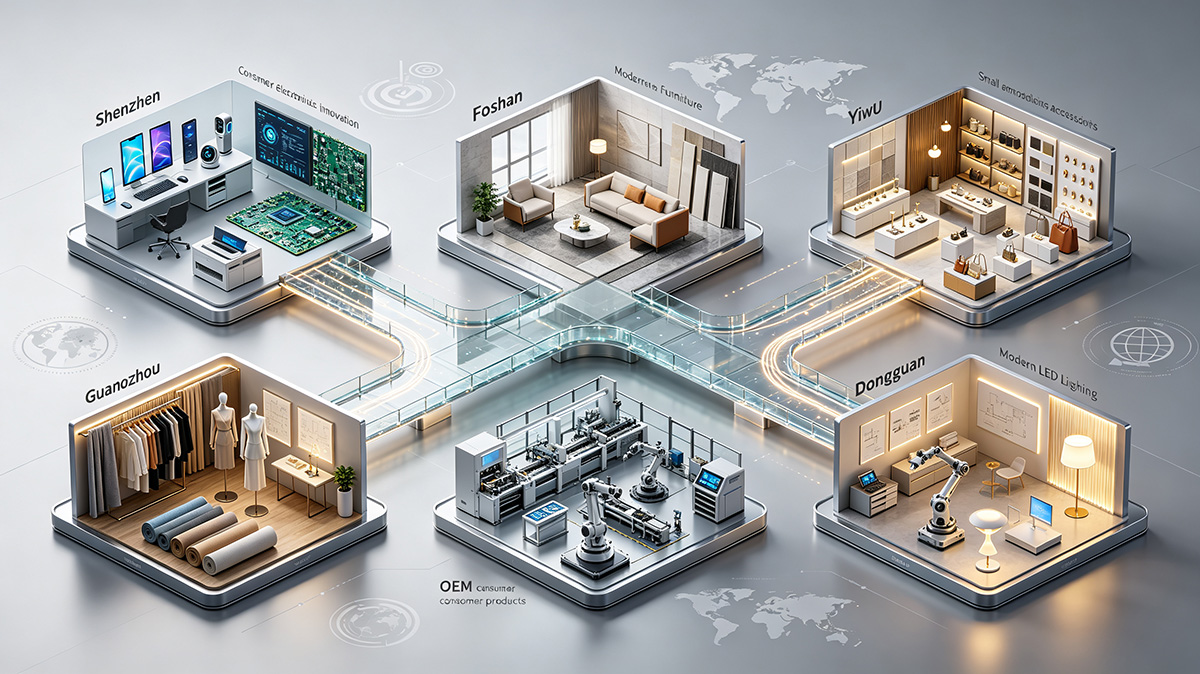
Electronics are concentrated in places such as Shenzhen and Dongguan.
Furniture and building materials are strongly associated with Foshan.
Small commodities are a major strength of Yiwu.
Apparel and fashion products have deep supplier networks in Guangzhou.
Lighting has a particularly strong cluster in Zhongshan.
This means choosing the right sourcing city can make a significant difference in supplier selection, pricing, product development, quality control, and logistics.
So, where should you go?
- Shenzhen — Electronics & Technology
Best for:
- Consumer electronics
- Phone accessories
- Smart devices
- PCBA and electronic components
- IoT products
- Computer accessories
- Drones and other technology products
Shenzhen is one of China’s most important electronics ecosystems.
Its advantage isn’t simply the number of electronics suppliers. It is the depth of the surrounding supply chain.
A product may require:
Components → PCB → Assembly → Testing → Packaging → Finished Product
Many of these capabilities can be found within the broader Shenzhen–Dongguan manufacturing region.
For buyers developing electronics or private-label technology products, this can make Shenzhen particularly attractive.
However, electronics also require careful supplier verification.
Specifications, components, certifications, batteries, and product compliance should be clearly defined before production.
Best for: Buyers who need technology, customization, rapid product development, or access to a deep electronics supply chain.
- Guangzhou — Apparel, Fashion & Consumer Goods
Best for:
- Clothing
- Fashion accessories
- Bags
- Shoes
- Leather goods
- Beauty-related products
- Textiles
- General consumer goods
Guangzhou is one of southern China’s major commercial and wholesale centers.
The city has extensive specialized markets and supplier networks, particularly in apparel, leather goods, footwear, and fashion-related products.
For buyers who want to compare many designs, price levels, and suppliers in a relatively concentrated market, Guangzhou can be a practical starting point.
It is especially useful for businesses that care about:
- Product variety
- Fast style changes
- Flexible sourcing
- Wholesale purchasing
- Fashion-oriented products
However, a wholesale market seller is not necessarily the factory.
If your goal is long-term OEM production, make sure you understand who you are actually buying from.
- Yiwu — Small Commodities & Mixed Products
Best for:
- Gifts
- Small household products
- Accessories
- Toys
- Stationery
- Decorations
- Seasonal products
- General merchandise
Yiwu is fundamentally different from cities that are primarily factory-oriented.
Its biggest strength is variety.
For buyers who need to source many different types of relatively small products, Yiwu can be extremely efficient.
The market ecosystem also makes it attractive for buyers with relatively small quantities or mixed-product requirements.
For example, an importer might source:
- Party supplies
- Home accessories
- Small toys
- Gift items
- Seasonal decorations
from multiple suppliers and then consolidate the cargo.
But there is an important distinction:
A seller in Yiwu is not necessarily a manufacturer.
If you need deep customization, proprietary molds, or large-scale production, you may eventually need to locate the actual factory behind the product.
- Foshan — Furniture & Building Materials
Best for:
- Furniture
- Sofas
- Cabinets
- Tables and chairs
- Ceramic products
- Tiles
- Sanitary ware
- Hardware
- Building materials
- Home improvement products
For furniture and home-related products, Foshan is one of the most important sourcing destinations in China.
The city has developed a dense ecosystem covering furniture, ceramics, hardware, home products, and related manufacturing.
This is particularly useful for overseas buyers who want to compare:
Design → Materials → Finishes → Packaging → Price
in person.
For furniture importers, however, product selection is only half the problem.
You also need to think about:
- Carton dimensions
- CBM
- Container utilization
- Packaging strength
- Loading method
- Damage prevention
A furniture supplier with a slightly lower unit price may not be the cheapest option if its packaging uses significantly more space.
- Dongguan — OEM & Consumer Manufacturing
Best for:
- Electronics
- Consumer products
- Toys
- Packaging
- Hardware
- Furniture components
- Sporting goods
- OEM/ODM manufacturing
Dongguan sits within the broader manufacturing ecosystem of the Pearl River Delta and is particularly valuable for buyers looking for factory-based production rather than simply wholesale products.
Its proximity to Shenzhen also makes it convenient for sourcing products that depend on the electronics and technology supply chain.
Dongguan can be especially attractive for businesses that already have:
- Product specifications
- Target quantities
- Packaging requirements
- Branding requirements
- OEM/ODM requirements
In other words:
Yiwu is often excellent for finding products.
Dongguan can be better suited to developing and manufacturing products.
The distinction matters.
- Ningbo — Hardware, Tools & Home Products
Best for:
- Hardware
- Tools
- Plastic products
- Household products
- Small appliances
- General consumer goods
Ningbo is both an important manufacturing region and a major export gateway.
Its industrial base includes a wide range of manufacturing businesses, particularly in hardware, plastics, tools, household products, and related industries.
For importers, the combination of manufacturing capability and strong port infrastructure can make the region particularly attractive.
This is especially relevant for businesses buying full-container quantities.
- Zhongshan — Lighting & Electrical Products
Best for:
- LED lighting
- Lamps
- Light fixtures
- Electrical products
- Lighting components
- Decorative lighting
Zhongshan, particularly the Guzhen area, has developed a highly specialized lighting ecosystem.
For lighting buyers, sourcing within a concentrated cluster can provide access to:
- Manufacturers
- Component suppliers
- Packaging suppliers
- Design services
- Related hardware
The benefit of a mature cluster is that you are not relying on a single factory.
You can compare multiple suppliers within the same ecosystem.
For electrical and lighting products, however, compliance should be considered from the beginning.
Certification requirements, electrical specifications, product testing, and destination-market regulations should be confirmed before placing a large order.
- Shantou / Chenghai — Toys
Best for:
- Toys
- Games
- Children’s products
- Plastic toys
- Seasonal novelty products
Chenghai in Shantou is another important specialized manufacturing cluster, particularly for toys and related products.
For toy importers, however, sourcing is not simply about finding the lowest factory price.
Product safety and regulatory compliance are critical.
Before importing children’s products, buyers should understand the applicable requirements in their destination market.
Quick Guide: Which City Should You Choose?
| Product | Recommended Sourcing City |
| Electronics | Shenzhen |
| OEM consumer products | Dongguan |
| Clothing & fashion | Guangzhou |
| Bags & leather goods | Guangzhou |
| Small commodities | Yiwu |
| Gifts & accessories | Yiwu |
| Furniture | Foshan |
| Building materials | Foshan |
| Lighting | Zhongshan |
| Hardware & tools | Ningbo |
| Toys | Shantou / Chenghai |
| Home products | Ningbo / Foshan |
These are starting points—not absolute rules.
China’s manufacturing supply chains overlap, and many products can be sourced from several cities.
The important thing is to understand where the strongest supplier cluster is located.
Don’t Choose a City Based on Product Price Alone
Choosing the right city is only the first step.
You still need to evaluate the supplier.
A low factory quotation doesn’t necessarily mean a low total cost.
You should also consider:
- Product quality
- MOQ
- Production capacity
- Packaging
- Lead time
- Export experience
- Certifications
- Communication
- Payment terms
- Shipping costs
And there’s another factor many buyers overlook:
Logistics.
Your Sourcing City Also Affects Your Shipping Plan
Where you buy your products can influence how they reach the export port.
For example, sourcing from several factories across different cities may create additional inland transportation and consolidation requirements.
A buyer might find a slightly cheaper supplier—but then discover that moving the cargo to the appropriate consolidation warehouse costs more than expected.
This is why sourcing and logistics should not be treated as completely separate decisions.
A better approach is:
Product → Supplier → Factory Location → Consolidation → Port → Destination
Think about the entire chain before making your final purchasing decision.
Should You Source From One City or Multiple Cities?
It depends on your business.
If you are importing one major product category, concentrating your sourcing in one industrial cluster may simplify:
- Supplier management
- Quality control
- Factory visits
- Cargo collection
- Consolidation
- Transportation
If you are importing multiple product categories, however, using several sourcing regions may be unavoidable.
For example:
Furniture → Foshan
Electronics → Shenzhen
Small accessories → Yiwu
The key is to plan consolidation and transportation before the goods are ready.
The Biggest Mistake: Choosing the Wrong City
One of the most expensive sourcing mistakes is starting with:
“Where can I find the cheapest supplier?”
A better question is:
“Where is the strongest manufacturing cluster for my product?”
Once you identify the right cluster, you have a much better chance of finding:
- More qualified suppliers
- Better product knowledge
- More competitive pricing
- Better supporting industries
- More efficient logistics
Final Thoughts
China doesn’t have one single “best sourcing city.”
There is no universal answer.
The right city depends on what you’re buying.
Electronics? Start with Shenzhen.
Furniture? Look at Foshan.
Small commodities? Consider Yiwu.
Fashion? Guangzhou.
OEM manufacturing? Dongguan.
Lighting? Zhongshan.
Hardware and home products? Ningbo.
The smartest sourcing strategy is not to search everywhere.
It’s to start where the industry is already concentrated.
Because when you source from the right manufacturing cluster, you’re not just finding a supplier.
You’re tapping into an entire supply chain.