
The U.S. auto industry is pushing Washington to go beyond tariffs.
On September 3, the Alliance for Automotive Innovation urged Congress to permanently ban the sale, import and manufacture of Chinese connected vehicles, as well as certain Chinese automotive hardware and software, before the end of the current congressional session.
The argument is no longer simply about cheap imports.
It is increasingly about technology, data, cybersecurity and supply-chain security.
And that distinction matters.
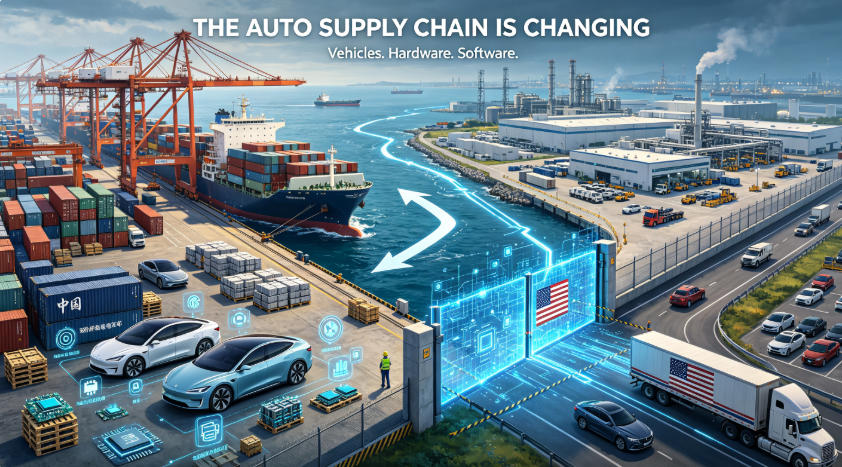
From finished vehicles to the entire technology stack
The proposed restrictions could affect much more than Chinese-branded cars.
Modern vehicles depend on:
• Batteries and power electronics
• Semiconductors and electronic control units
• Bluetooth, Wi-Fi and cellular connectivity
• Vehicle operating systems and software
• Sensors and other connected-vehicle technologies
That means the real battleground may not be “Chinese cars vs. American cars.”
It could become:
China → Components → Technology → Vehicle → U.S. Market
The bigger supply-chain question
For importers, manufacturers and logistics providers, this creates a more complicated environment.
A component manufactured in China may be incorporated into a vehicle elsewhere.
A vehicle assembled outside China may still contain Chinese-origin technology.
And a company with international ownership or manufacturing operations may have to prove that its supply chain does not fall within restricted categories.
In other words, country of origin alone may no longer tell the whole story.
What should importers watch?
Companies involved in the automotive supply chain should pay closer attention to:
- Country of origin and substantial transformation
- Supplier ownership and corporate structure
- Component-level sourcing
- HS classification
- Software and connected-vehicle technology
- Customs documentation and traceability
- S. import restrictions and compliance requirements
The U.S. auto market may be moving toward a model where “Where was the vehicle made?” is only the first question.
The next question could be:
“Where did its critical technology come from?”
This is a major shift for global automotive supply chains.
For companies sourcing automotive parts from China, supply-chain planning will increasingly require more than freight rates and transit times.
Compliance, origin, technology exposure and regulatory risk may become just as important as logistics cost.
Global automotive trade is becoming more strategic—and supply chains will have to adapt accordingly.