
China has announced a further two-month extension of the suspension of additional tariffs on imports originating from the United States. The decision helps maintain the current trade arrangement between the two economies, but it does not mean that all additional tariffs have been removed.
For businesses involved in China–U.S. trade, the announcement offers some short-term certainty. However, the next two months may prove important in determining whether the current trade truce can develop into a more stable framework.
- What Has China Actually Announced?
According to the announcement by China’s Customs Tariff Commission of the State Council, the adjustment will take effect at 1:01 p.m. on November 10, 2026, Beijing time.
The key measures are:
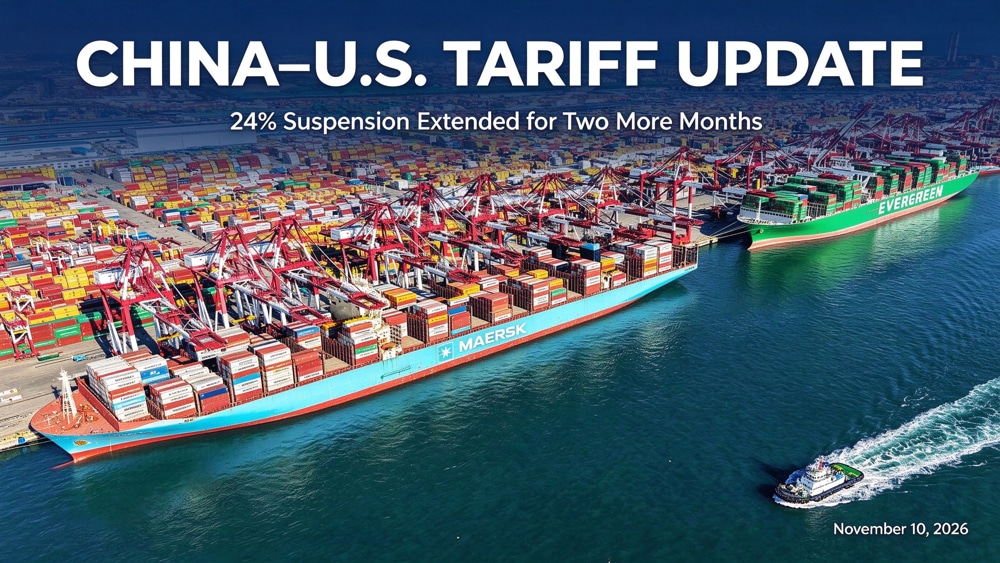
- The suspension of the additional 24% tariff on U.S.-origin imports will continue for another two months.
- The additional 10% tariff will remain in place.
- China will continue to monitor subsequent U.S. trade measures and may adjust its countermeasures accordingly.
The distinction is important: China is extending the suspension of part of its additional tariffs, not eliminating the entire additional tariff burden.
For importers, the current 10% additional tariff remains a factor in calculating landed costs, alongside ordinary customs duties and any other applicable trade measures.
- A Temporary Extension, Not a Complete Trade Settlement
The decision reflects the consensus reached between the Chinese and U.S. heads of state during their September meeting in Washington.
Both sides have been working to extend the period of trade stability and explore further tariff adjustments. The latest announcement helps prevent an immediate escalation when the previous suspension period was due to expire.
However, the two-month extension should not be mistaken for a permanent solution.
One important issue is the U.S. government’s intention to consider replacing tariffs imposed under the International Emergency Economic Powers Act (IEEPA) with measures under Section 301 of the Trade Act of 1974.
China has explicitly highlighted this issue in its announcement and stated that it will closely monitor subsequent U.S. actions.
This means the current tariff arrangement remains conditional on developments in bilateral trade policy.
In other words, the immediate risk of a tariff increase has been reduced, but the possibility of renewed trade friction remains.
- Why Section 301 Matters
Section 301 is an important U.S. trade enforcement mechanism that allows the U.S. government to investigate and respond to what it considers unfair foreign trade practices.
If the United States uses Section 301 to introduce new or replacement tariffs, the impact could extend beyond the current tariff arrangement.
For companies importing from or exporting to China, this creates several uncertainties:
- Whether additional tariffs will be introduced on specific product categories.
- Whether existing tariff arrangements will be modified.
- Whether certain industries will face greater scrutiny.
- Whether businesses will need to reconsider sourcing locations and supply-chain structures.
The key issue is not simply the tariff rate today, but whether companies can reasonably predict the tariff environment over the next several months.
For importers, tariff uncertainty can be just as challenging as high tariffs themselves.
- What Does This Mean for International Logistics?
Tariff policy does not directly determine freight rates, but it can influence purchasing decisions, shipment schedules, sourcing strategies and international cargo flows.
The latest extension may have several potential implications.
First, it provides a short-term planning window.
Businesses trading between China and the United States have more time to arrange orders, review customs costs and coordinate shipment schedules without facing an immediate increase from the suspended 24% tariff.
Second, it may support more stable cargo planning.
When tariff uncertainty decreases, some importers may feel more comfortable proceeding with previously delayed orders. This could support shipment activity, although actual cargo growth will depend on market demand, product prices and the implementation of other trade arrangements.
Third, sourcing decisions remain sensitive to tariff exposure.
Importers will continue comparing China with alternative manufacturing locations. A temporary tariff extension may reduce the pressure to make sudden sourcing changes, but it is unlikely to eliminate long-term supply-chain diversification.
Fourth, customs compliance remains essential.
Importers should not assume that the suspension applies to every product or removes all additional duties. Product classification, country of origin, applicable tariff measures and customs documentation still need to be reviewed carefully.
- What Should Importers Do During the Next Two Months?
For businesses importing from China or exporting to the United States, this is a good time to review their supply-chain arrangements rather than simply wait for the next policy announcement.
Consider the following steps:
- Recalculate landed costs. Confirm the applicable ordinary duties and additional tariffs for each product.
- Review product classification. Check HS codes and country-of-origin requirements instead of relying on general tariff headlines.
- Plan shipments carefully. Coordinate production completion, cargo pickup, customs clearance and delivery schedules.
- Avoid making sourcing decisions based on temporary measures alone. Compare total landed costs, production capacity, lead times and compliance risks.
- Monitor policy developments. Pay particular attention to the implementation of reciprocal tariff arrangements and any new U.S. trade measures.
A lower or temporarily suspended tariff does not automatically mean a lower total import cost. Freight, insurance, customs clearance, inland transportation and other charges remain part of the overall calculation.
- The Bigger Picture: Stability Is Valuable, but Predictability Matters More
The latest announcement is a positive development for businesses that depend on China–U.S. trade. It reduces the risk of an immediate tariff escalation and provides another short period for both sides to continue negotiations.
But the broader question remains unresolved: Can the two economies move from temporary tariff suspensions toward a more predictable and sustainable trade framework?
For global supply chains, predictability is often as important as the tariff rate itself.
Importers need to know not only how much they will pay today, but also whether their sourcing and logistics decisions will remain commercially viable several months from now.
The next two months will therefore be worth watching closely.
For businesses moving cargo between China and the United States, the message is clear: use this window to review costs, strengthen compliance and prepare for more than one possible trade-policy outcome.