For many importers, one of the most satisfying messages to receive from a supplier is:
“Your cargo is ready.”
After weeks of production, the goods have finally been manufactured, packed, and prepared for shipment.
It feels like the hardest part is over.
But in international trade, this is often where another important stage begins.
The factory has finished making the product.
Now you have to move it.
And getting cargo from a factory to your warehouse involves much more than simply booking a vessel.
Production Completion Is Not Delivery Completion
A common mistake among new importers is treating production and logistics as separate processes.
The thinking often looks like this:
Place order → Factory produces goods → Ship → Receive goods
In reality, there are many steps between production completion and final delivery.
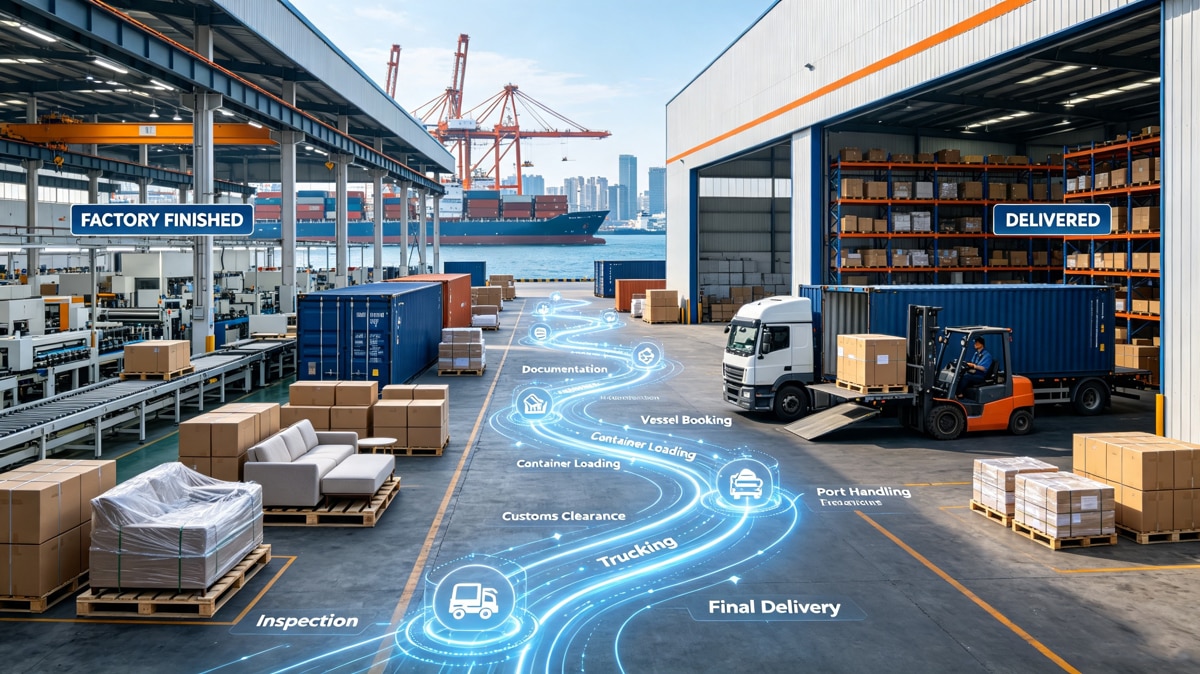
A typical shipment may involve:
Production → Inspection → Packaging → Documentation → Booking → Pickup → Container Loading → Export Customs → Ocean Freight → Import Customs → Port Handling → Trucking → Final Delivery
Every stage needs to be coordinated.
A problem at any point can affect the entire shipment.
What Happens After the Factory Finishes?
- Cargo Inspection
Before the goods leave the factory, importers may need to verify:
- Product quantity
- Product quality
- Packaging condition
- Carton dimensions
- Labels and markings
- Shipping specifications
Discovering a problem before departure is usually much easier than discovering it after the cargo has crossed the ocean.
- Shipping Documents
The cargo may be ready physically, but the paperwork also needs to be ready.
Depending on the shipment, documents may include:
- Commercial invoice
- Packing list
- Bill of lading information
- Product certificates
- Origin documentation
- Other regulatory documents
The information across these documents should be accurate and consistent.
A cargo shipment cannot move smoothly if its documentation is incomplete or incorrect.
- Freight Booking
Once the cargo is ready, transportation capacity needs to be arranged.
During normal periods, this may be relatively straightforward.
During peak seasons, however, preferred vessel space can fill quickly.
Waiting until the last minute can result in:
- Higher freight rates
- Fewer sailing options
- Longer waiting times
- Potential rollovers
This is one reason experienced importers begin freight planning before production is completed.
- Pickup and Container Loading
The cargo still needs to get from the factory to the appropriate loading location.
This requires coordination between:
- Supplier
- Trucking company
- Warehouse
- Freight forwarder
Container loading also matters.
Poor loading can increase the risk of:
- Cargo movement
- Product damage
- Uneven weight distribution
- Inefficient use of container space
The objective isn’t simply to fill the container.
It’s to load it safely and efficiently.
- Export Customs Clearance
Before the shipment leaves the origin country, export customs procedures must be completed.
Incorrect product descriptions, missing documents, or other discrepancies can create delays.
This is why customs-related requirements should be considered before the cargo is ready—not after the truck has arrived at the warehouse.
- Ocean Transportation Is Only One Part of the Journey
Once the container is loaded onto the vessel, many importers feel that the shipment is finally “done.”
But the cargo still has to arrive at the destination and clear import procedures.
Depending on the shipment, the next stages may involve:
- Port arrival
- Import customs clearance
- Customs inspection
- Terminal handling
- Container pickup
- Drayage or trucking
- Final delivery
A vessel arriving at the destination port does not automatically mean the cargo is ready for delivery.
- Import Customs Clearance
Import customs is one of the most important stages of the process.
Customs authorities may review:
- Product descriptions
- Declared values
- Tariff classification
- Country of origin
- Required certifications
- Intellectual property concerns
A shipment with incomplete or inaccurate information can experience delays even if transportation itself went perfectly.
Why Early Planning Matters
One of the biggest differences between experienced and inexperienced importers is when they start thinking about logistics.
An inexperienced importer may say:
“The factory isn’t finished yet. We’ll arrange shipping when the cargo is ready.”
An experienced importer may already be asking:
- What will the final carton dimensions be?
- How many cartons will there be?
- What is the estimated cargo volume?
- What shipping method should we use?
- Are there any product compliance requirements?
- When should we reserve space?
- How long will customs clearance take?
- When does the customer need delivery?
The difference is planning.
“Cargo Ready” Is Not the Same as “Delivery Ready”
This distinction is important.
Cargo Ready means the supplier has completed production and prepared the goods for shipment.
Delivery Ready means the cargo has successfully completed the necessary logistics and import processes and can reach its final destination.
There may be days—or weeks—between these two points.
That gap is where many logistics problems occur.
The Cost of Waiting Until the Last Minute
Waiting until production ends before starting logistics planning can create unnecessary costs.
For example:
Higher Freight Costs
Available vessel capacity may become limited.
Missed Sailing
Your cargo may not make the preferred departure.
Storage Charges
Delays can result in additional warehouse or terminal costs.
Inventory Shortages
Late shipments can affect product availability.
Missed Sales Opportunities
Seasonal products may arrive after the demand has already passed.
A small amount of planning can prevent much larger expenses later.
The Best Logistics Plans Start Before Production Ends
A strong import process connects purchasing, production, and logistics.
Instead of treating them as separate activities, they should work together.
For example:
Before production:
Confirm product requirements, packaging, compliance, and estimated shipping specifications.
During production:
Monitor production progress and update the estimated cargo volume and shipping schedule.
Before production finishes:
Prepare documents, confirm pickup arrangements, review the shipping plan, and reserve transportation capacity when appropriate.
After production:
Inspect, load, clear customs, and move the cargo according to the planned schedule.
This creates a much more predictable supply chain.
Final Thoughts
When the factory tells you:
“Your cargo is ready.”
Don’t think the logistics process is finished.
Think of it as the moment when the next phase begins.
Production creates the product.
Logistics turns that product into delivered inventory.
And successful importing depends on coordinating both.
Because the goal isn’t simply to manufacture your goods.
The goal is to get them where they need to be—on time, legally, safely, and at a predictable cost.
The factory finishes production. Your work is just beginning.